Structural composition of India is relying more on which sector?
Answer & explanation
Correct answer: option 4
The correct answer is Option (4) → Tertiary sector
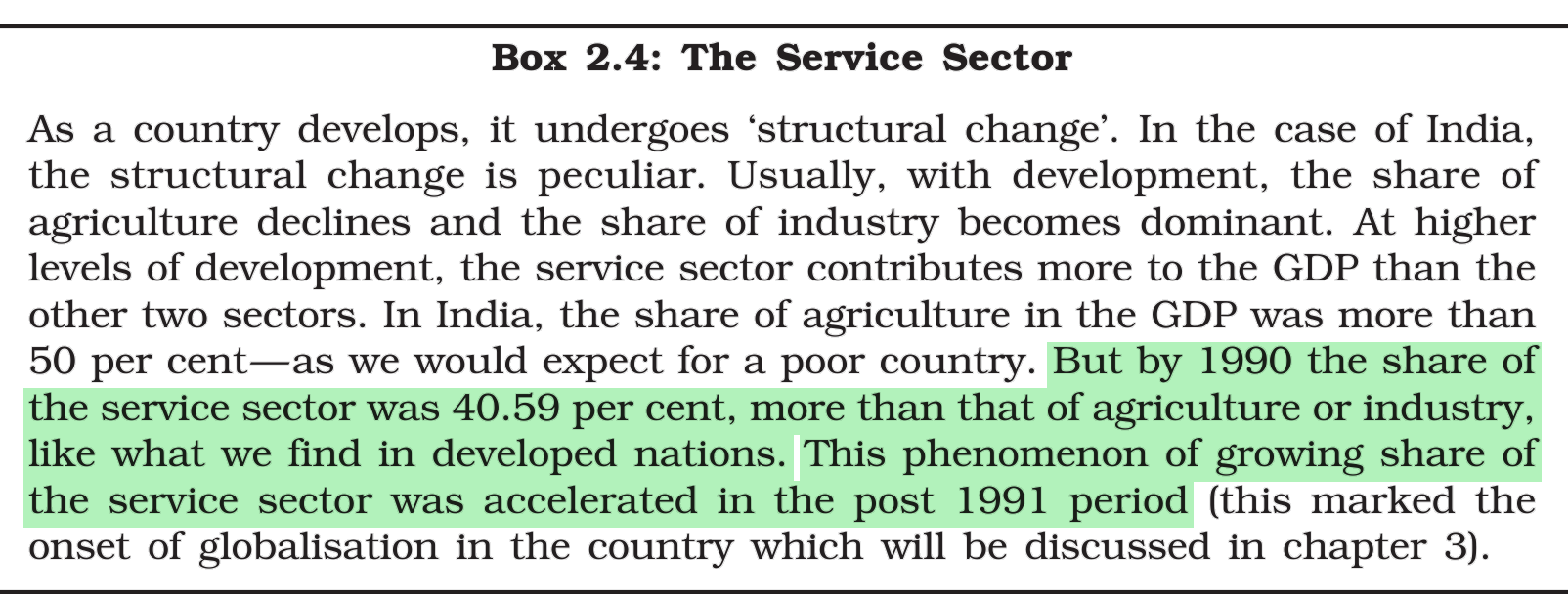
The structural composition of an economy is the share of each sector in its output (GDP). As a country develops, this share changes. Usually industry takes over from agriculture first. India’s change has been different: the service (tertiary) sector grew fastest. By 1990 its share in GDP was already more than that of agriculture or industry. After 1991, GDP growth has come mainly from services.
NCERT (2026-27): “3.6 Indian Economy during Reforms: An Assessment …In economics, the growth of an economy is measured by the Gross Domestic Product. … The post–1991 India witnessed a rapid growth in GDP on a continual basis for two decades. … During the reform period, the growth of agriculture has declined. While the industrial sector reported fluctuation, the growth of the service sector has gone up. This indicates that GDP growth is mainly driven by growth in the service sector.…” NCERT (2026-27), chapter ‘Indian Economy 1950-1990’: “…The GDP of a country is derived from the different sectors of the economy, namely the agricultural sector, the industrial sector and the service sector. The contribution made by each of these sectors makes up the structural composition of the economy. In some countries, growth in agriculture contributes more to the GDP growth, while in some countries the growth in the service sector contributes more to GDP growth (see Box 2.4).…”
|