
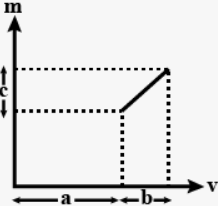
The graph shows the variation of the magnification (m) produced by a thin lens with image distance (v). The focal length of the lens is:
Answer & explanation
Correct answer: option 4
The correct answer is Option (4) → \( \displaystyle\frac{b}{c} \)
For a thin lens the lens formula \( \frac{1}{v} - \frac{1}{u} = \frac{1}{f} \) and the magnification \( m = \frac{v}{u} \) together give a straight-line relation between m and v. Substituting \( \frac{1}{u} = \frac{m}{v} \):
\( \displaystyle \frac{1-m}{v} = \frac{1}{f} \Rightarrow m = 1 - \frac{v}{f} \)
The graph rises as v increases, so it shows the magnitude of m. For the real image of a convex lens, \( |m| = \frac{v}{f} - 1 \), which is a straight line of slope \( 1/f \).
Read the two ends of the straight part of the graph: at \( v = a \) the magnification is \( m_1 \), and at \( v = a + b \) it is \( m_1 + c \).
\( \displaystyle |m_1| = \frac{a}{f} - 1 \), \( \displaystyle |m_1| + c = \frac{a+b}{f} - 1 \)
Subtracting the first from the second:
\( \displaystyle c = \frac{b}{f} \Rightarrow f = \frac{b}{c} \)
Shortcut: The distance a cancels when the two readings are subtracted, so the focal length can depend only on b and c. Only Option (4) is free of a.
Note: The graph rises with v, so it plots the magnitude of m (for a real image the signed magnification \( m = 1 - v/f \) is negative and falls with v). Read as a signed value the line would belong to a diverging lens with \( f = -b/c \); the magnitude \( b/c \) of the focal length is the same.