


CUET Preparation Today
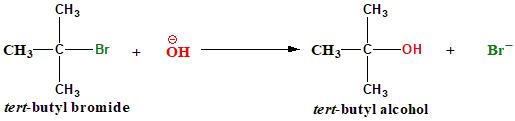
Substitution nucleophilic unimolecular $({S_N}^1)$ reaction is a two step process carried out in polar protic solvents, it follows kinetics of $(CH_3)_3C - Br +\overline OH →(CH_3)_3 COH + Br^-$. |
Zero order First order Second order Pseudo first order |
First order |
The correct answer is Option (2) → First order. The reaction between tert-butyl bromide and hydroxide ion to form tert-butyl alcohol follows first-order kinetics i.e., the rate depends on the concentration of one reactant only. It has been noted that the rate of reaction depends entirely on the alkyl halide concentration.
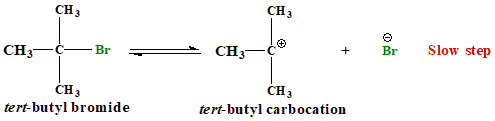
The rate of reaction may be expressed as: Rate = k[(CH3)3CBr] or simply, Rate = k [RX] This reaction is called substitution nucleophilic unimolecular because only one molecule is involved in the rate determining step of the reaction and is written as an SN1 reaction. These types of reactions are generally carried out in polar protic solvents such as water, alcohol, acetic acid, etc. The SN1 mechanism occurs in two steps. Step 1. Formation of a carbocation: The polarised C — halogen bond (C— Br) undergoes slow cleavage to form a carbocation and a halide ion.
Step 2. Nucleophilic attack on carbocation:The carbocation is very reactive species. Therefore, it readily reacts with a nucleophile, \(OH^–\) to form the product.
The first step is slow and can be reversed. It involves the cleavage of the C—Br bond for which energy is obtained through the solvation of bromide (halide) ion with the proton of the protic solvent. Since the slowest step is the rate determining step, the rate of reaction depends only on the concentration of tert-butyl bromide (alkyl halide). It is a first-order or unimolecular reaction as a result. The SN1 mechanism is facilitated by polar protic solvents such as water, alcohol, or aqueous organic solvents. These solvents promote the ionization step by stabilizing the ions by solvation. |