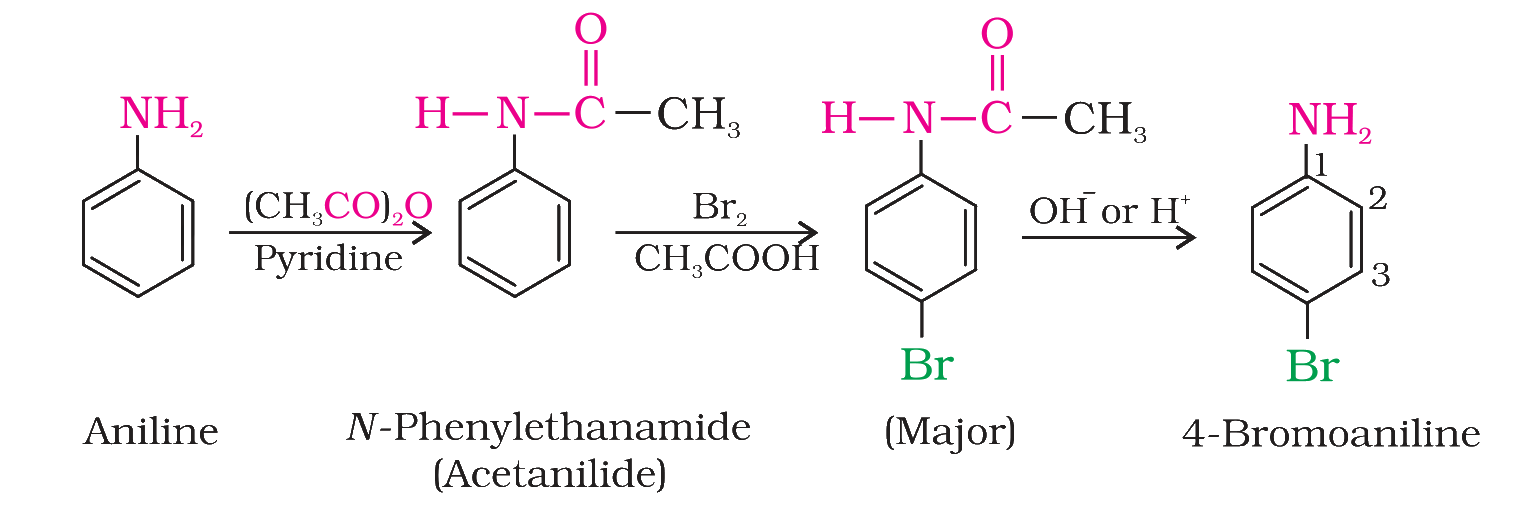
The amino group is ortho, para directing and a powerful activating group, so aryl amines undergo the typical electrophilic substitution reactions readily. In fact, the rate of these reactions is so great that in certain cases poly-substitution, rather than mono-substitution, occurs even under mild conditions. If the reaction has to be stopped at the mono-substitution stage, the activating effect of the –NH2 group has to be controlled.
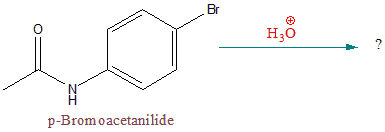
Identify the product of the given reaction.
Answer & explanation
Correct answer: option 2
The correct answer is Option (2) → p-Bromoaniline
To stop substitution of aniline at one group, the –NH2 group is first protected by acetylation; after the substitution, the amide is hydrolysed back to the amine.
p-Bromoacetanilide is the brominated amide, so the last step is left:
\( \displaystyle \ce{Br-C6H4-NHCOCH3 + H2O} \xrightarrow{\ce{H3O+}} \ce{Br-C6H4-NH2 + CH3COOH} \)
Acid hydrolysis breaks the amide C–N bond: the acetyl group leaves as acetic acid and the –NH2 group is set free. The Br on the ring is not touched, so the product is p-bromoaniline.
Why the other options are incorrect
Option (1) Acetanilide — Incorrect. It still carries the acetyl group and has lost the ring Br; hydrolysis does the opposite, removing the acetyl group and keeping the Br.
Option (3) Anilinium bromide — Incorrect. \( \ce{C6H5NH3^+Br^-} \) has no Br on the ring; the C–Br bond of the ring is not broken by hydrolysis.
Option (4) No reaction — Incorrect. The substituted amide is hydrolysed in acid; this is the step that removes the protecting group.
NCERT (2026-27 edition):
9.6 Chemical Reactions – “… If we have to prepare monosubstituted aniline derivative, how can the activating effect of –NH2 group be controlled ? This can be done by protecting the -NH2 group by acetylation with acetic anhydride, then carrying out the desired substitution followed by hydrolysis of the substituted amide to the substituted amine.”