
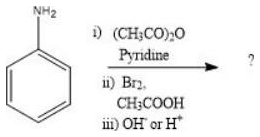
The final major product of the following reaction is
Answer & explanation
Correct answer: option 1
The correct answer is Option (1) → 4-bromoaniline (p-bromoaniline)
The –\( \ce{NH2} \) group is a very strong activating group. With bromine, aniline reacts at once at both ortho positions and the para position, giving 2,4,6-tribromoaniline. To get a single bromine atom, the activating effect has to be reduced first.
This is done by acetylation. In the –\( \ce{NHCOCH3} \) group, the lone pair on nitrogen is shared with the neighbouring C=O group, so it is less available to the ring. The group is still o,p-directing, but only moderately activating, and its bulk blocks the ortho positions. The protecting group is removed at the end by hydrolysis.
So the product is 4-bromoaniline (p-bromoaniline).
Why the other options are incorrect
Option (2) 3,5-dibromoaniline — Incorrect. Both bromine atoms are meta to the –\( \ce{NH2} \) group. The –\( \ce{NHCOCH3} \) group directs ortho and para, and the reduced activation lets only one bromine atom enter.
Option (3) 3-bromoaniline — Incorrect. The bromine atom is meta to the –\( \ce{NH2} \) group; the –\( \ce{NHCOCH3} \) group directs ortho and para.
Option (4) 2,5-dibromoaniline — Incorrect. It has two bromine atoms, one of them meta to the –\( \ce{NH2} \) group. The acetyl group reduces the activation enough that only one bromine atom enters, at the para position.
NCERT (2026-27 edition):
Bromination – “… The main problem encountered during electrophilic substitution reactions of aromatic amines is that of their very high reactivity. Substitution tends to occur at ortho- and para-positions. … This can be done by protecting the -NH2 group by acetylation with acetic anhydride, then carrying out the desired substitution followed by hydrolysis of the substituted amide to the substituted amine.”
“… Hence, the lone pair of electrons on nitrogen is less available for donation to benzene ring by resonance. Therefore, activating effect of –NHCOCH3 group is less than that of amino group.”
Note: The same/similar question has been asked in different years by NTA as per the details given below:
| 2026 | 2025 | 2024 | 2023 | 2022 |
|---|---|---|---|---|
| 07-06 S2 18-05 S1 | – | – | – | – |