Isomerism shown by \([Co(NH_3)_3(NO_2)_3]\) is
Answer & explanation
Correct answer: option 2
The correct answer is Option (2) → Facial and meridional
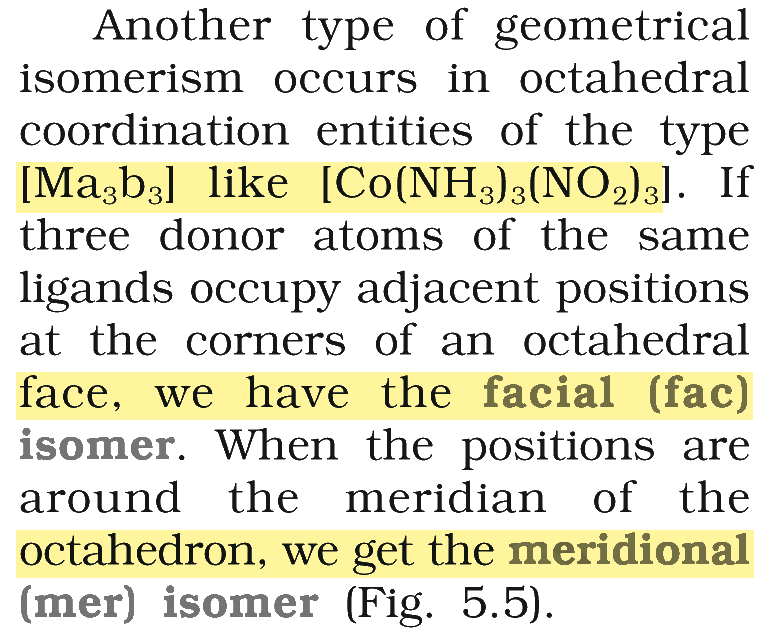
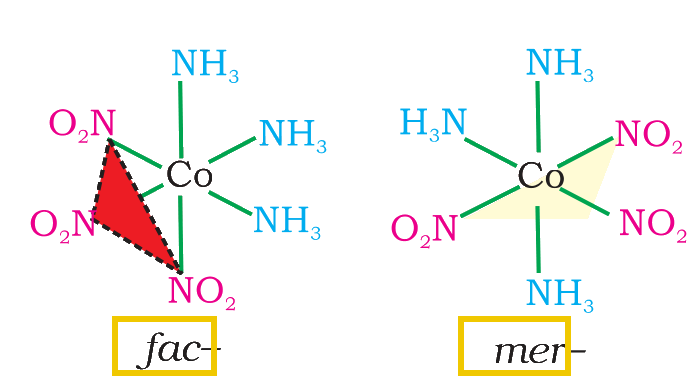
An octahedral complex of the type [Ma3b3] shows a special kind of geometrical isomerism. If the three identical ligands occupy the corners of one face of the octahedron, the isomer is facial (fac). If they lie around a meridian (in one plane passing through the metal), the isomer is meridional (mer).
\( \ce{[Co(NH3)3(NO2)3]} \) has three \( \ce{NH3} \) and three \( \ce{NO2^{-}} \) ligands around \( \ce{Co^{3+}} \) (x + 0 + 3(−1) = 0, x = +3), so it is an [Ma3b3] complex and shows fac and mer isomerism.
Why the other options are incorrect
Option (1) Cis and trans — Incorrect. This geometrical isomerism is shown by [Ma4b2] octahedral complexes (e.g. \( \ce{[Co(NH3)4Cl2]^{+}} \)) and [Ma2b2] square planar ones; for [Ma3b3] the two isomers are called fac and mer.
Option (3) Optical — Incorrect. Needs a complex with no plane of symmetry, such as \( \ce{[Co(en)3]^{3+}} \) or cis-\( \ce{[CoCl2(en)2]^{+}} \); both fac and mer \( \ce{[Co(NH3)3(NO2)3]} \) have a mirror plane.
Option (4) Solvate — Incorrect. Isomers that differ in whether water is a ligand or water of crystallisation, e.g. \( \ce{[Cr(H2O)6]Cl3} \) and \( \ce{[Cr(H2O)5Cl]Cl2} \)·\( \ce{H2O} \); there is no water here.
NCERT (2026-27 edition):
Geometric Isomerism – …