The demand curves of two consumers are \( d_1(p)=10-p \) and \( d_2(p)=15-p. \) Find the market demand when price is 16 for the commodity.
Answer & explanation
Correct answer: option 4
The correct answer is Option (4) → 0
Given:
Demand of consumer 1, d1(p) = 10 − p
Demand of consumer 2, d2(p) = 15 − p
Price, p = 16
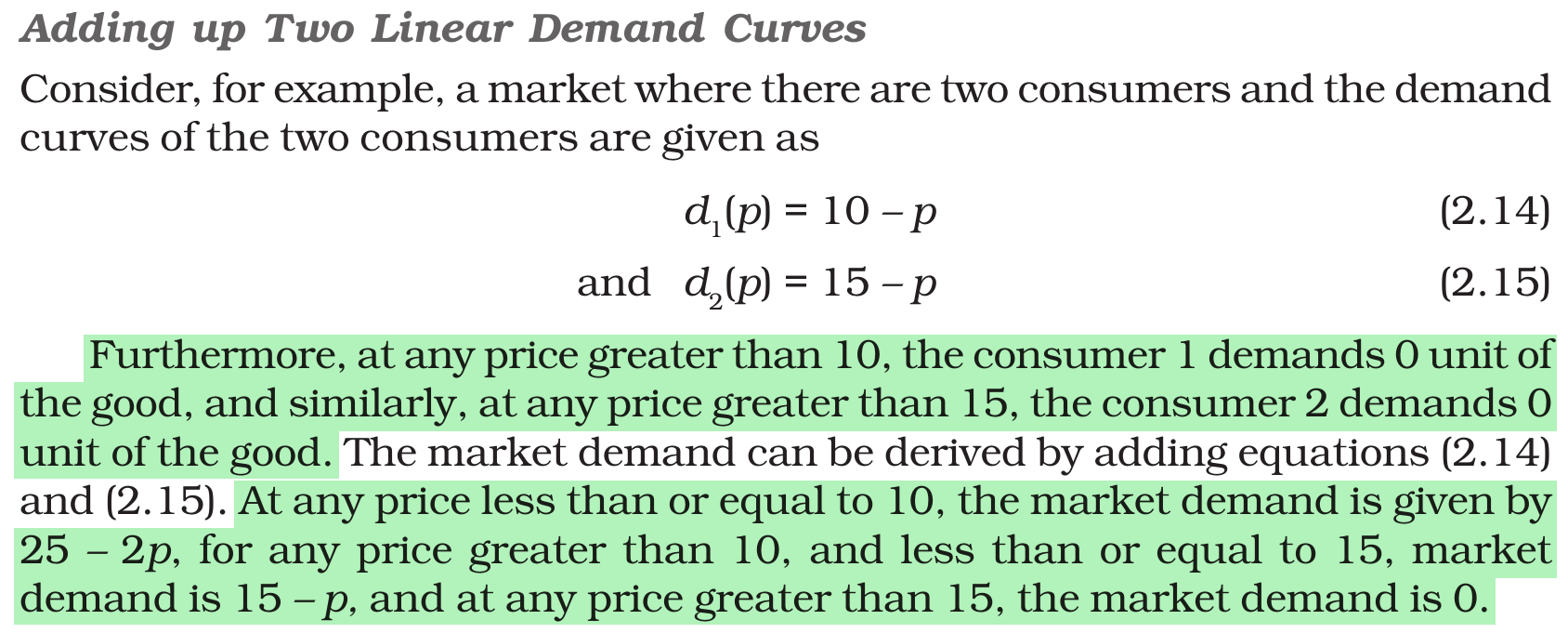
The market demand at a price is the total demand of all consumers at that price. A consumer cannot buy less than zero. So consumer 1 buys nothing at any price above 10, and consumer 2 buys nothing above 15:
d1(16) = 0, since 16 is above 10
d2(16) = 0, since 16 is above 15
Market demand = 0 + 0 = 0
Putting p = 16 straight into the two formulas gives −6 and −1, a total of −7. A negative quantity has no meaning, so each formula holds only up to the price at which it reaches zero.
NCERT (2026-27): Introductory Microeconomics — Chapter 2: Theory of Consumer Behaviour
|