
There are two types of fertilisers 'A' and 'B'. 'A' consists of 12% nitrogen and 5% phosphoric acid whereas 'B' consists of 4% nitrogen and 5% phosphoric acid. After testing the soil conditions, farmer finds that he needs atleast 12 kg of nitrogen and 12 kg of phosphoric acid for his crops. If 'A' costs ₹10 per kg and 'B' costs ₹8 per kg, then graphically determine how much of each type of fertiliser should be used so that nutrient requirements are met at a minimum cost.
Answer & explanation
Correct answer: option 2
The correct answer is Option (2) → ₹1980
Let x kg of fertiliser A and y kg of fertiliser B be used and Z (in ₹) be the total cost of the two fertilisers, then $Z = 10x + 8y$. The problem can be formulated as an L.P.P. as follows:
Minimise $Z = 10x + 8y$ subject to the constraints
$\frac{12}{100}x+ \frac{4}{100}y ≥ 12$ i.e. $3x + y ≥ 300$ (nitrogen constraint)
$\frac{5}{100}x+ \frac{5}{100}y ≥ 12$ i.e. $x + y ≥ 240$ (phosphoric constraint)
$x ≥ 0, y ≥0$ (non-negativity constraints)
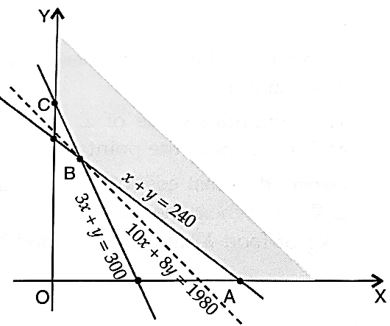
Draw the lines $3x + y = 300, x + y = 240$ and shade the region satisfied by the above inequalities.
The feasible region (unbounded, convex) is shown shaded. The corner points are A (240, 0), B (30, 210) and C(0,300).
The values of Z at the corner points are:
at $A (240, 0), Z = 10 × 240 + 0 = 2400;$
at $B(30, 210), Z = 10 × 30 + 8 × 210 = 1980;$
at $C(0, 300), Z = 8 × 300 +0 = 2400$.
Among values of Z, the least value is 1980. We draw the line $10x + 8y = 1980$ (shown dotted in the given figure) and note that the half plane $10x + 8y < 1980$ has no common points with the feasible region, therefore, Z has minimum value.
Minimum value of Z is 1980 and it occurs at the point B (30, 210).
Hence, the minimum cost of the fertiliser is ₹1980 when he uses 30 kg of fertiliser A and 210 kg of fertiliser B.