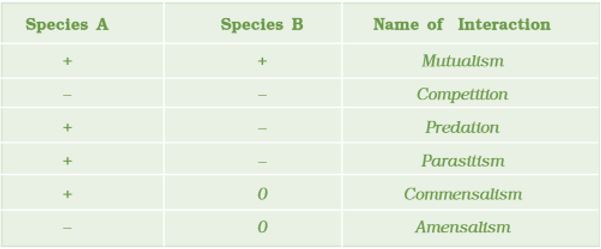
Match List-I with List-II
|
List-I Population interactions |
List-II Species A/ Species B |
|
(A) Amensalism |
(I) - / - |
|
(B) Commensalism |
(II) + / - |
|
(C) Predation |
(III) + / 0 |
|
(D) Competition |
(IV) - / 0 |
'-' sign for detrimental interaction '+' sign for beneficial interaction. '0' sign for neutral interaction,
Choose the correct answer from the options given below.
Answer & explanation
Correct answer: option 2
The correct answer is Option (2) → (A)-(IV), (B)-(III), (C)-(II), (D)-(I)
|
List-I Population interactions |
List-II Species A/ Species B |
|
(A) Amensalism |
(IV) - / 0 |
|
(B) Commensalism |
(III) + / 0 |
|
(C) Predation |
(II) + / - |
|
(D) Competition |
(I) - / - |
A. In amensalism, one species is harmed whereas the other is unaffected.
B. Commensalism: This is the interaction in which one species benefits and the other is neither harmed nor benefited. An orchid growing as an epiphyte on a mango branch, and barnacles growing on the back of a whale benefit while neither the mango tree nor the whale derives any apparent benefit. The cattle egret and grazing cattle in close association, a sight you are most likely to catch if you live in farmed rural areas, is a classic example of commensalism.
C. Predation is a natural process that involves one organism (the predator) capturing, killing, and consuming another organism (the prey) for food. It is an essential mechanism for transferring energy from lower trophic levels to higher trophic levels in ecological food chains. Predators play a crucial role in regulating prey populations, maintaining the balance of ecosystems, and promoting biodiversity. Predation is a natural process that occurs in all ecosystems. It is a way for energy to be transferred from one trophic level to another. The predator benefits from the interaction, while the prey is harmed or killed.
D. Competition is best defined as a process in which the fitness of one species (measured in terms of its ‘r’ the intrinsic rate of increase) is significantly lower in the presence of another species. It is relatively easy to demonstrate in laboratory experiments, as Gause and other experimental ecologists did, when resources are limited the competitively superior species will eventually eliminate the other species, but evidence for such competitive exclusion occurring in nature is not always conclusive. Connell’s elegant field experiments showed that on the rocky sea coasts of Scotland, the larger and competitively superior barnacle Balanus dominates the intertidal area, and excludes the smaller barnacle Chathamalus from that zone.