
Read the given passage and answer the questions that follow:
The word AIDS means deficiency of immune system acquired during the lifetime of an individual indicating that it is not a congenital disease. AIDS was first reported in 1981 and in the last 25 years it has spread all over the world killing more than 25 million persons. AIDS is caused by the HIV (Human Immuno deficiency Virus). The people who are at high risk of getting this infection include the individuals who have multiple sexual partners, drug addicts who take drugs intravenously, individuals who require repeated blood transfusions and children born to an HIV infected mother. It is imperative for the physical and psychological well-being that the HIV / AIDS infected persons are not isolated from the family and society. A widely used diagnostic test for AIDS is ELISA.
How does HIV decrease natural immunity of the body?
Answer & explanation
Correct answer: option 3
The correct answer is Option (3) → Attacking T-lymphocytes
Helper T-lymphocytes (TH cells) are central to the immune response; for example, they help B-cells make antibodies. HIV first enters macrophages, which keep producing the virus. It also enters helper T-lymphocytes, multiplies inside them, and the new viruses attack more helper T-cells. Their number keeps falling, so the body can no longer fight even common infections.
Option (1) Destroying antibodies — Incorrect. HIV does not destroy antibodies directly. Fewer antibodies are made only because the helper T-cells that help B-cells are lost.
Option (2) Destroying erythrocytes — Incorrect. Erythrocytes (red blood cells) carry oxygen and are not part of the immune defence. HIV does not target them.
Option (3) Attacking T-lymphocytes — Correct. HIV enters and kills helper T-lymphocytes. Their number falls steadily, and the person becomes immunodeficient, suffering from infections the body could otherwise overcome.
Option (4) Attacking B-lymphocytes — Incorrect. B-lymphocytes make antibodies. HIV does not attack them directly; they work less well because the helper T-cells they depend on are destroyed.
NCERT Extract:
AIDS – “After getting into the body of the person, the virus enters into macrophages where RNA genome of the virus replicates to form viral DNA with the help of the enzyme reverse transcriptase. This viral DNA gets incorporated into host cell’s DNA and directs the infected cells to produce virus particles (Figure 7.6). The macrophages continue to produce virus and in this way acts like a HIV factory. Simultaneously, HIV enters into helper T-lymphocytes (TH), replicates and produce progeny viruses. The progeny viruses released in the blood attack other helper T-lymphocytes. This is repeated leading to a progressive decrease in the number of helper T-lymphocytes in the body of the infected person.”
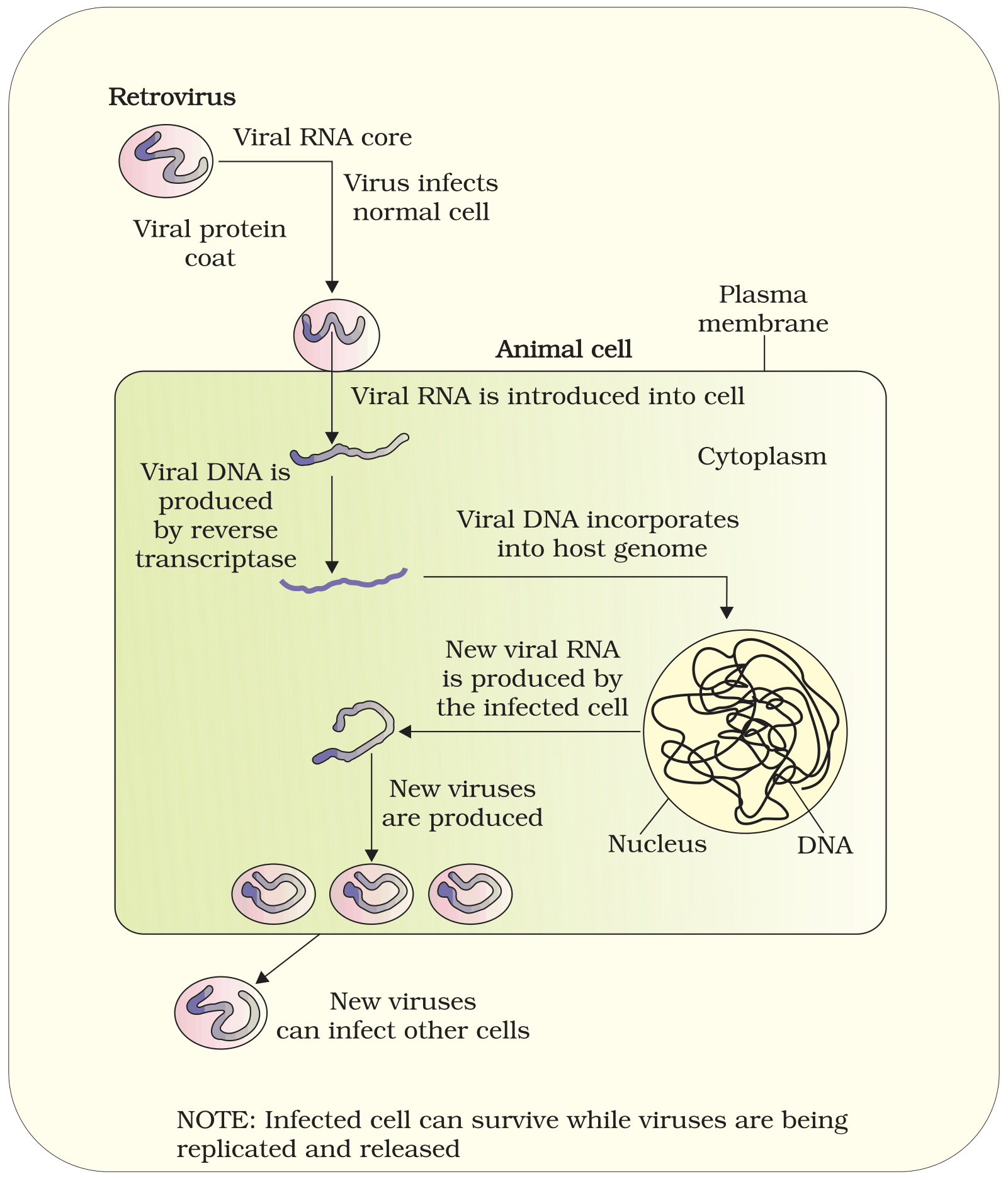
Figure 7.6 Replication of retrovirus