
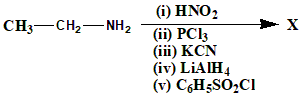
\(X\) is:
Answer & explanation
Correct answer: option 3
The correct answer is Option (3) → N-propylbenzenesulphonamide, C6H5SO2NHCH2CH2CH3
Each reagent changes one functional group; the KCN step adds one carbon to the chain.
First, nitrous acid converts the primary aliphatic amine into an unstable diazonium salt, which loses \( \ce{N2} \) and gives ethanol:
\( \ce{CH3CH2NH2 + HNO2 -> CH3CH2OH + N2 ^ + H2O} \)
\( \ce{PCl3} \) then replaces the –OH group by –Cl:
\( \ce{3CH3CH2OH + PCl3 -> 3CH3CH2Cl + H3PO3} \)
KCN substitutes the chlorine by –CN (nucleophilic substitution), giving propanenitrile; the chain now has three carbons:
\( \ce{CH3CH2Cl + KCN -> CH3CH2CN + KCl} \)
\( \ce{LiAlH4} \) reduces the nitrile to a primary amine, propan-1-amine:
\( \ce{CH3CH2C#N} \xrightarrow{\ce{LiAlH4}} \ce{CH3CH2CH2NH2} \)
Finally, benzenesulphonyl chloride (Hinsberg’s reagent) reacts with this primary amine to form a sulphonamide:
\( \ce{C6H5SO2Cl + H2NCH2CH2CH3 -> C6H5SO2NHCH2CH2CH3 + HCl} \)
So X is N-propylbenzenesulphonamide. Its N–H hydrogen is acidic (strong electron-withdrawing sulphonyl group), so it dissolves in alkali.
Why the other options are incorrect
Option (1) N-ethylbenzenesulphonamide — Incorrect. This is what Hinsberg’s reagent gives with ethanamine itself; it ignores the KCN step, which adds a carbon.
Option (2) N-ethyl-N-methylbenzenesulphonamide — Incorrect. A sulphonamide with no N–H forms only from a secondary amine (here N-methylethanamine); the sequence gives a primary amine.
Option (4) N-isopropylbenzenesulphonamide — Incorrect. This would need propan-2-amine. The –CN group is attached at the end of the chain, so the reduction gives the straight-chain propan-1-amine.
NCERT (2026-27 edition):
Reaction with Arylsulphonyl Chloride – “Benzenesulphonyl chloride (C6H5SO2Cl), which is also known as Hinsberg’s reagent, reacts with primary and secondary amines to form sulphonamides.
(a) The reaction of benzenesulphonyl chloride with primary amine yields N-ethylbenzenesulphonyl amide.”