CUETMOCK
  • Pricing
  • Mentors
Log inStart freeStart free mocks→

First test, then trust

Try a free CUET mock test.

Join 5,00,000+ students who rehearsed exam day on the exact NTA screen before sitting CUET. On the web and on Android.

Start free mocks →Get the Android app
CUETMOCK

India's #1 CUET Mock Test Platform. Original NCERT-based questions on the exact NTA exam screen — trusted by 5,00,000+ students since CUET 2022.

Get it onGoogle PlayScan to download the CUETMOCK app

Mock tests

  • CUET mock test series
  • Browse all papers
  • Commerce mocks
  • Humanities (Arts) mocks
  • Science mocks
  • Languages & GAT mocks
  • Free practice questions
  • Pricing

Resources

  • CUET exam guide
  • CUET syllabus
  • Universities accepting CUET
  • Expert blogs
  • News & notifications
  • Webinars & counselling
  • CUET score calculator
  • How we estimate your rank
  • FAQs

Company

  • About us
  • Our leadership & team
  • Our toppers
  • Mentors
  • For schools
  • Contact us
  • Terms
  • Privacy
  • Refund policy

Talk to us

+91 7696 6630 56info@cuetmock.comWhatsApp us

Our other platforms

  • JEE Mock — For IIT-JEE aspirants
  • NEET Mock — For NEET aspirants

Newsletter

Exam updates, study material and offers — no spam.

© 2026 NYC Ventures Pvt. Ltd.

701-702, Royal Business Park, Zirakpur, Punjab - 140603

  • Terms of use
  • Privacy policy
  • Refund policy
  • Contact us

iCUETMOCK is an independent preparation platform, not affiliated with the National Testing Agency (NTA). Always check exam details on the official NTA website.

  • Home
  • Mock tests
  • CUET guide
  • Pricing
  • Log in
Home/Practice questions/General Aptitude Test
General Aptitude TestNon-Verbal ReasoningCounting of Figures

Find the number of triangles and squares in the given figure.
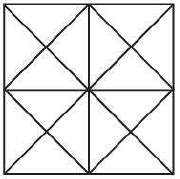
Find the number of triangles and squares in the given figure.

Answer & explanation+

Correct answer: option 3

The correct answer is Option (3) → 44 triangles, 10 squares

The figure is a big square cut into four small squares, each with both its diagonals drawn. The diagonals of the four small squares also join into the two diagonals of the big square and into a tilted square through the midpoints of its sides, so shapes are counted size by size.

Triangles:

  • Smallest triangles, four in each small square: \(4\times4=16\)

  • Half a small square (cut off by one diagonal), four in each small square: \(4\times4=16\)

  • Triangles on each side of the big square with their tip at the centre (one quarter of the big square): 4

  • Halves of the middle tilted square: 4

  • Halves of the big square (cut off by a big diagonal): 4

  • Total: \(16+16+4+4+4=44\)

Squares:

  • The four small squares and the big square: 5

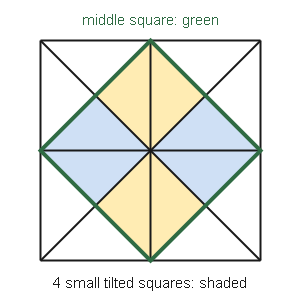
  • The middle tilted square (green below) and the four small tilted squares inside it (shaded): 5

  • Total: \(5+5=10\)

Figure for the solution

Advertisement

Practise more on Non-Verbal Reasoning

Chapter-wise mocks on the real NTA exam screen, with solutions and your rank. Your first mocks are free.

Start free mocks →

Advertisement

Next questions

  1. If k <0, then the number of roots of the equation ke^x - x = 0, is _____.Maths. Section B1 · Relations and Functions
  2. The river Tiber flows through which of the following capital cities?General Aptitude Test · General Knowledge
  3. P and Q were sharing profit and losses in the 3:2. They decided to dissolve the partnership. There was a Deferred Advertisement Expenditure…Accountancy Part A · Dissolution of Partnership Firm
  4. What was the aim of trade policy introduced in 1991?Economics · Indian Economic Development: Liberalisation, Privatisation and Globalisation - An Appraisal
  5. X is:Chemistry · Organic: Amines
  6. Which of the following statements is correct?Statement A- West Asia, specifically the Gulf region, accounts for about 30 per cent of global…Political Science · Contemporary World Politics: Environment and Natural Resources
  7. Which of the following is NOT one of the major fish producing states of India?Economics · Indian Economic Development: Rural Development
  8. Arrange the following EM waves in increasing order of their frequency ?A. Ultraviolet raysB. Gamma raysC. Radio wavesD. Infrared wavesE. X-…Physics · Electromagnetic Waves
  9. "It has totally reduced distance, broken all man-made barriers, and made our world a small place." Which chief trait of the internet is bei…English · Comprehension - (Narrative / Factual)
  10. According to the Supreme Court order, every protected forest, national park and wildlife sanctuary across the country should have a mandato…General Aptitude Test · Current Affairs