What is the best suitable condition for the preparation of diazonium salts?
Choose the correct answer from the options given below:
Answer & explanation
Correct answer: option 1
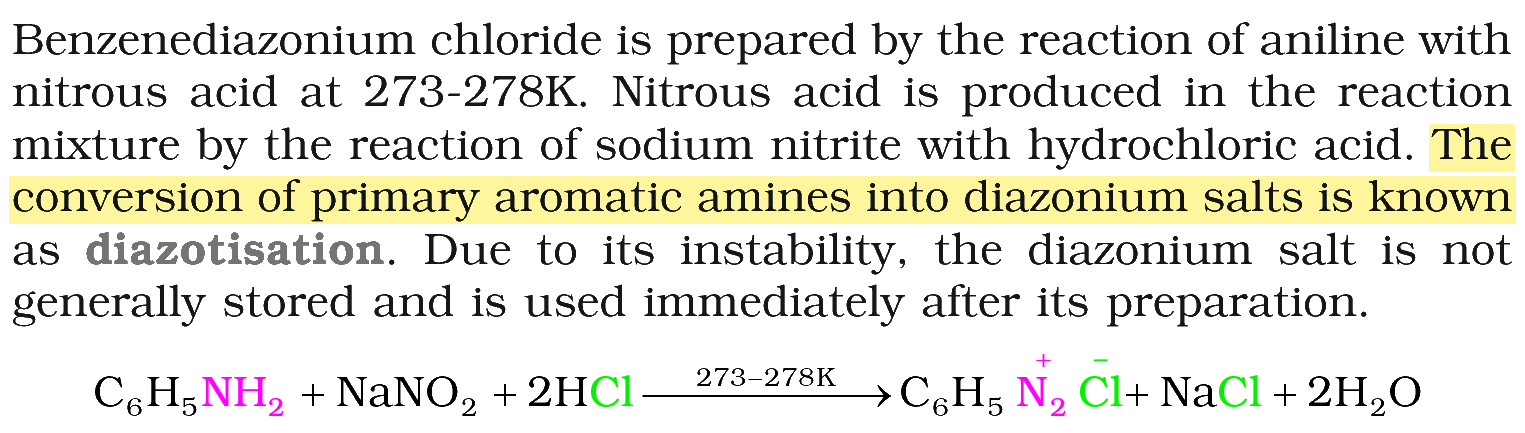
The correct answer is Option (1) → Reaction of aromatic primary amine with nitrous acid at 273-278 K.
A diazonium salt is made from a primary aromatic amine and nitrous acid in the cold, at 273-278 K. Nitrous acid is unstable, so it is produced in the reaction mixture from sodium nitrite and hydrochloric acid. The low temperature is needed because arenediazonium salts decompose at higher temperatures; they are stable in the cold because the positive charge is delocalised into the benzene ring.
Why the other options are incorrect
Option (2) Reaction of aliphatic amine with nitrous acid at 273-278 K. — Incorrect. An aliphatic amine also reacts with nitrous acid (made from \( \ce{NaNO2} \) and HCl), but its diazonium salt is very unstable. It decomposes at once, giving an alcohol and nitrogen gas:
\( \displaystyle \ce{RNH2 + HNO2 -> ROH + N2 ^ + H2O} \)
Option (3) Reaction of aromatic primary amine with nitric acid at 273-278 K. — Incorrect. Nitric acid (\( \ce{HNO3} \)) is not a diazotising agent. With aniline it acts as a nitrating and oxidising agent: direct nitration of aniline gives tarry oxidation products along with nitro derivatives, and no diazonium salt.
Option (4) Reaction of aliphatic amine with nitric acid at 273-278 K. — Incorrect. An aliphatic amine is a base, so with nitric acid it only forms a salt, an alkylammonium nitrate. No diazonium salt is formed:
\( \displaystyle \ce{RNH2 + HNO3 -> RNH3^+NO3^-} \)
NCERT (2026-27 edition):
Method of Preparation of Diazonium Salts