CUETMOCK
  • Pricing
  • Mentors
Log inStart freeStart free mocks→

First test, then trust

Try a free CUET mock test.

Join 5,00,000+ students who rehearsed exam day on the exact NTA screen before sitting CUET. On the web and on Android.

Start free mocks →Get the Android app
CUETMOCK

India's #1 CUET Mock Test Platform. Original NCERT-based questions on the exact NTA exam screen — trusted by 5,00,000+ students since CUET 2022.

Get it onGoogle PlayScan to download the CUETMOCK app

Mock tests

  • CUET mock test series
  • Browse all papers
  • Commerce mocks
  • Humanities (Arts) mocks
  • Science mocks
  • Languages & GAT mocks
  • Free practice questions
  • Pricing

Resources

  • CUET exam guide
  • CUET syllabus
  • Universities accepting CUET
  • Expert blogs
  • News & notifications
  • Webinars & counselling
  • CUET score calculator
  • How we estimate your rank
  • FAQs

Company

  • About us
  • Our leadership & team
  • Our toppers
  • Mentors
  • For schools
  • Contact us
  • Terms
  • Privacy
  • Refund policy

Talk to us

+91 7696 6630 56info@cuetmock.comWhatsApp us

Our other platforms

  • JEE Mock — For IIT-JEE aspirants
  • NEET Mock — For NEET aspirants

Newsletter

Exam updates, study material and offers — no spam.

© 2026 NYC Ventures Pvt. Ltd.

701-702, Royal Business Park, Zirakpur, Punjab - 140603

  • Terms of use
  • Privacy policy
  • Refund policy
  • Contact us

iCUETMOCK is an independent preparation platform, not affiliated with the National Testing Agency (NTA). Always check exam details on the official NTA website.

  • Home
  • Mock tests
  • CUET guide
  • Pricing
  • Log in
Home/Practice questions/History
HistoryAncient India: Kinship, Caste and Class

Arrange the following textual traditions in a chronological order. (A…

Arrange the following textual traditions in a chronological order.

(A) Charaka and Sushruta Samhitas
(B) Natyashastra of Bharata
(C) Manusmriti
(D) Sanskrit plays of Kalidasa
(E) Ashtadhyayi of Panini

Choose the correct answer from the options given below:

Answer & explanation+

Correct answer: option 1

The correct answer is Option (1) → (E), (C), (A), (B), (D)

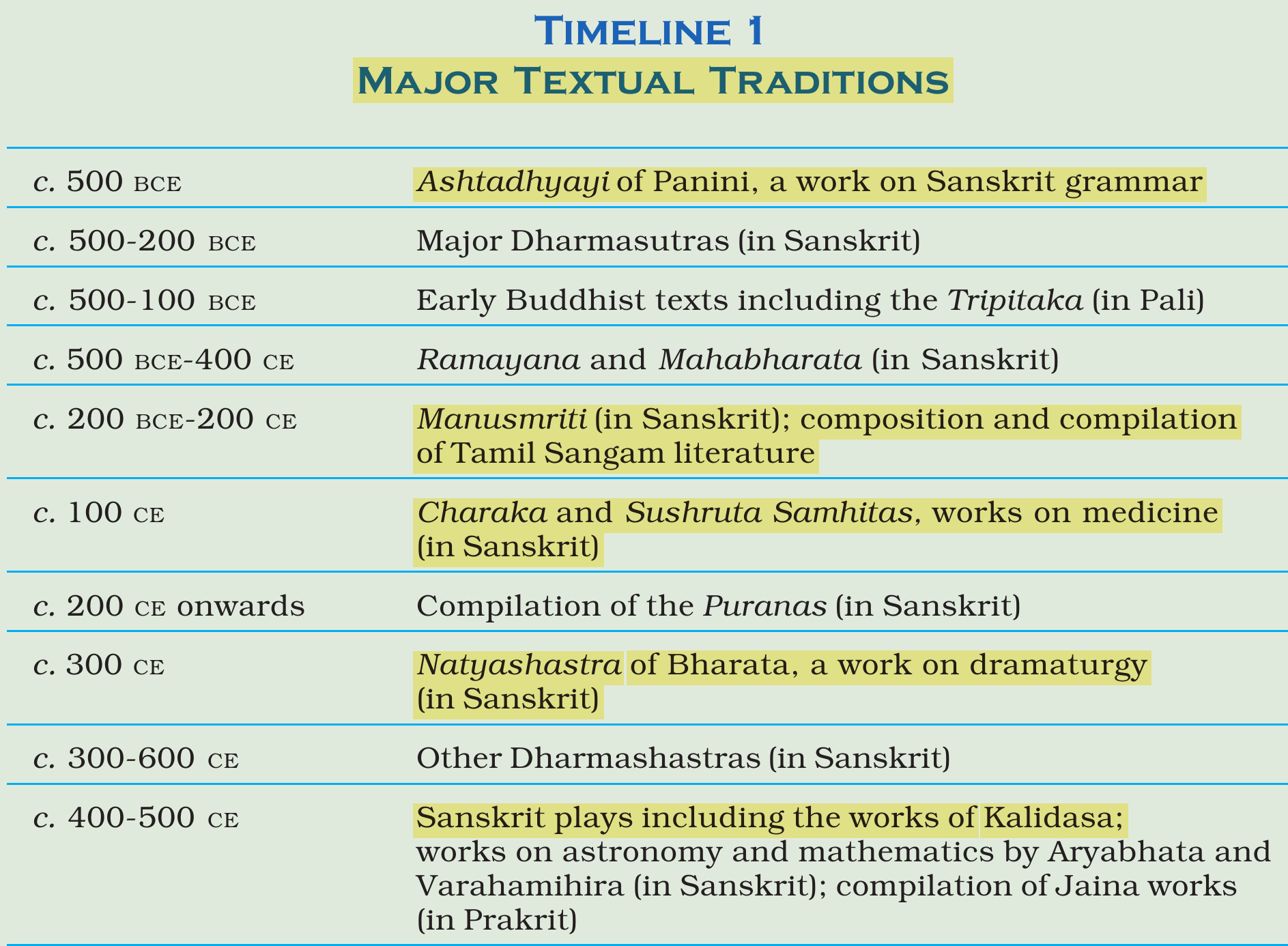
(E) Ashtadhyayi of Panini — c. 500 BCE, a work on Sanskrit grammar, the earliest of the five.

(C) Manusmriti — c. 200 BCE-200 CE, in Sanskrit.

(A) Charaka and Sushruta Samhitas — c. 100 CE, works on medicine in Sanskrit.

(B) Natyashastra of Bharata — c. 300 CE, a work on dramaturgy.

(D) Sanskrit plays of Kalidasa — c. 400-500 CE, the latest of the five.

Note: The question is not properly framed, as the dates of C and A overlap. The book’s timeline dates the Manusmriti to c. 200 BCE-200 CE, a period that also covers the Charaka and Sushruta Samhitas (c. 100 CE). So A does not fall strictly after C. However, the period of the Manusmriti begins long before c. 100 CE, and Option (1) is the only option that follows the order of the timeline; Option (4), which also begins with the Ashtadhyayi of Panini, puts the plays of Kalidasa (c. 400-500 CE) second. Therefore, Option (1) is the most appropriate answer.


NCERT: Themes in Indian History Part I — Chapter 3: Kinship, Caste and Class (2026-27)

NCERT extract

Advertisement

Practise more on Ancient India: Kinship, Caste and Class

Chapter-wise mocks on the real NTA exam screen, with solutions and your rank. Your first mocks are free.

Start free mocks →

Advertisement

Next questions

  1. The moon is an example of a ______ object.General Aptitude Test · General Knowledge
  2. Select the option that is related to the fifth number in the same way as the second number is related to the first number and the fourth nu…General Aptitude Test · General Ability
  3. The antonym of the word 'antagonism' is _________.English · Antonyms
  4. According to Section............. of the partnership Act 1932, the dissolution of partnership between all the partners of a firm is called…Accountancy Part A · Dissolution of Partnership Firm
  5. The narrator's younger self would be incredulous if she saw the narrator now, as:English · Comprehension - (Narrative / Factual)
  6. Raman spends 50 percent of his income. If his income increases by 10 percent and the expenditure also increases by 10 percent, then what wi…General Aptitude Test · Numerical Ability
  7. What is the other name for Shifting cultivation ?Geography · Fundamentals of Human Geography: Primary Activities
  8. Polymers are not classified on the basis of which of the following?Chemistry · Organic: Polymers
  9. Das and Naglieri developed a battery of tests known as the:Psychology · Variations in Psychological Attributes
  10. The earth behaves as a magnet with the magnetic field pointing geographically from which direction to which direction?Physics · Magnetism and Matter