
Read the passage carefully and answer the questions.
Alcohols and phenols are formed when a hydrogen atom in a hydrocarbon, aliphatic and aromatic respectively is replaced by - OH group. These are further classified on the basis of number of hydroxy groups and according to the hybridization of the carbon atom $sp^2$ or $sp^3$ to which the -OH group is attached. They find applications in industry as well as in day-to-day life. One of the most commercially obtained alcohol also known as wood spirit is obtained by destructive distillation of wood. Both alcohols and phenols are acidic in nature. The acidity of alcohols and phenols vary according to the nature of substituent(s) attached to them. Alcohols and phenols react with carboxylic acids, acid chlorides and acid anhydrides to form esters. Introduction of acetyl group in alcohols and phenols is called acetylation. Phenol undergo electrophilic aromatic substitution reaction because the -OH activates the benzene ring. It undergoes nitration, halogenation and sulphonation reactions.
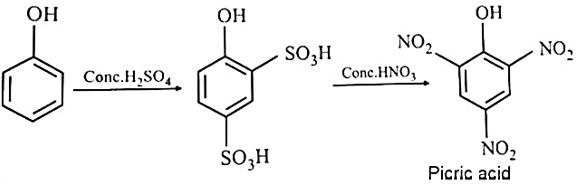
When phenol is treated with concentrated sulphuric acid, then it gets converted into phenol-2,4-disulphonic acid (X). On further treatment of X with conc. nitric acid, product Y is formed. Identify Y.
Answer & explanation
Correct answer: option 2
The correct answer is Option (2) → Picric acid **
Phenol contains an –OH group, which is a strong activating and ortho–para directing group in electrophilic substitution reactions.
Step 1: Sulphonation
When phenol is treated with concentrated H₂SO₄, sulphonation occurs and phenol forms:
Phenol-2,4-disulphonic acid
Here –SO₃H groups occupy the 2 and 4 positions of the benzene ring.
Step 2: Nitration
When this compound is treated with concentrated HNO₃, the –SO₃H groups are replaced by – NO₂ groups during nitration.
As a result, three nitro groups are introduced at the 2, 4, and 6 positions of the benzene ring.
Thus the product formed is:
2,4,6-trinitrophenol, commonly known as picric acid.
Option-wise Explanation
Option 1: Salicylic acid
Salicylic acid is formed through the Kolbe–Schmitt reaction, not through nitration of phenol disulphonic acid. Hence incorrect.
Option 2: Picric acid
Nitration of phenol-2,4-disulphonic acid replaces sulfonic groups with nitro groups to produce 2,4,6-trinitrophenol (picric acid). Hence correct.
Option 3: o-Nitrophenol
This compound forms during mild nitration of phenol, not through this reaction sequence. Hence incorrect.
Option 4: 2,4-dinitrophenol
Further nitration leads to three nitro groups, not two. Hence incorrect.