
$ABCD$ is a rhombus whose diagonals intersect at $E$. Then $\vec{EA} + \vec{EB} + \vec{EC} + \vec{ED}$ equals to
Answer & explanation
Correct answer: option 1
The correct answer is Option (1) → $\vec{0}$ ##
Given, $ABCD$ is a rhombus whose diagonals bisect each other.
$|\vec{EA}| = |\vec{EC}|$
and $|\vec{EB}| = |\vec{ED}|$
but since they are opposite to each other so they are of opposite signs.
$\Rightarrow \vec{EA} = -\vec{EC}$
and $\vec{EB} = -\vec{ED}$
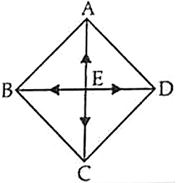
$\Rightarrow \vec{EA} + \vec{EC} = \vec{0} \quad \dots(i)$
and $\vec{EB} + \vec{ED} = \vec{0} \quad \dots(ii)$
Adding (i) and (ii), we get
$\vec{EA} + \vec{EB} + \vec{EC} + \vec{ED} = \vec{0}.$