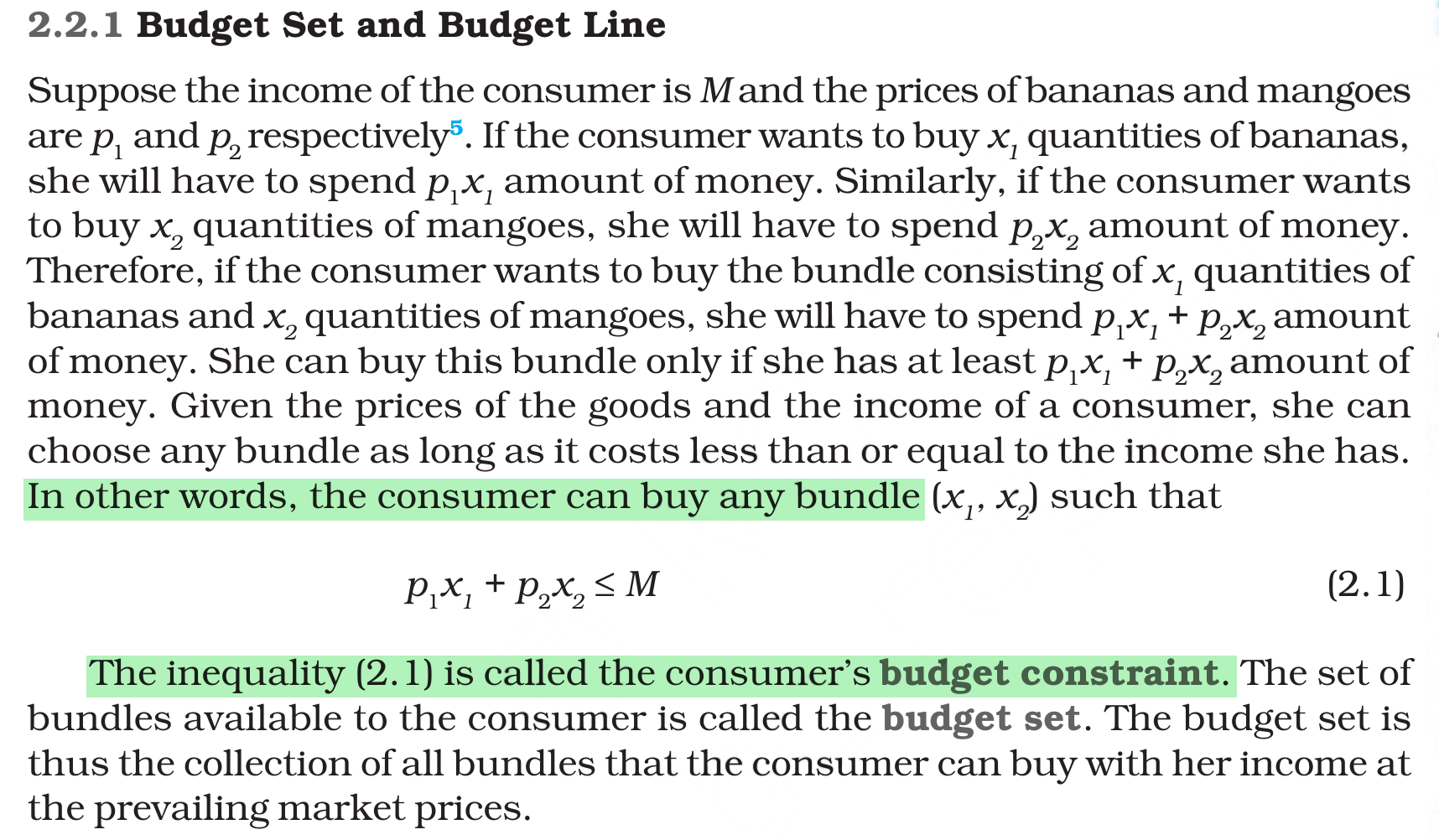
Given the prices of goods and income of the consumers, the consumer can buy any bundle (X1, X2) such that P1X1 + P2X2 ≤ M. This inequality in the above equation is called_________.
Answer & explanation
Correct answer: option 2
The correct answer is Option (2) → Consumer’s Budget Constraint
No consumer can buy everything: what can be bought is limited by the income M and the prices P1 and P2. Whatever bundle is picked must cost no more than the income, which is what P1X1 + P2X2 ≤ M says. This limit is the consumer’s budget constraint, and the bundles that satisfy it form the budget set.
Why the other options are incorrect
Option (1) Consumer’s Indifference Curve — Incorrect. An indifference curve joins bundles that give the consumer the same satisfaction. It shows the consumer’s preferences, not what the consumer can afford.
Option (3) Consumer’s Budget Line — Incorrect. The budget line is the set of bundles that cost just as much as the consumer’s income, P1X1 + P2X2 = M. It is the equation, not the inequality, and forms only the boundary of the budget set.
Option (4) Consumer’s Total Budget — Incorrect. There is no such term.
NCERT: Introductory Microeconomics — Chapter 2: Theory of Consumer Behaviour (2025-26)
|