CUETMOCK
  • Pricing
  • Mentors
Log inStart freeStart free mocks→

First test, then trust

Try a free CUET mock test.

Join 5,00,000+ students who rehearsed exam day on the exact NTA screen before sitting CUET. On the web and on Android.

Start free mocks →Get the Android app
CUETMOCK

India's #1 CUET Mock Test Platform. Original NCERT-based questions on the exact NTA exam screen — trusted by 5,00,000+ students since CUET 2022.

Get it onGoogle PlayScan to download the CUETMOCK app

Mock tests

  • CUET mock test series
  • Browse all papers
  • Commerce mocks
  • Humanities (Arts) mocks
  • Science mocks
  • Languages & GAT mocks
  • Free practice questions
  • Pricing

Resources

  • CUET exam guide
  • CUET syllabus
  • Universities accepting CUET
  • Expert blogs
  • News & notifications
  • Webinars & counselling
  • CUET score calculator
  • How we estimate your rank
  • FAQs

Company

  • About us
  • Our leadership & team
  • Our toppers
  • Mentors
  • For schools
  • Contact us
  • Terms
  • Privacy
  • Refund policy

Talk to us

+91 7696 6630 56info@cuetmock.comWhatsApp us

Our other platforms

  • JEE Mock — For IIT-JEE aspirants
  • NEET Mock — For NEET aspirants

Newsletter

Exam updates, study material and offers — no spam.

© 2026 NYC Ventures Pvt. Ltd.

701-702, Royal Business Park, Zirakpur, Punjab - 140603

  • Terms of use
  • Privacy policy
  • Refund policy
  • Contact us

iCUETMOCK is an independent preparation platform, not affiliated with the National Testing Agency (NTA). Always check exam details on the official NTA website.

  • Home
  • Mock tests
  • CUET guide
  • Pricing
  • Log in
Home/Practice questions/History
HistoryMedieval India: Through the Eyes of Travellers

Arrange the following foreign travellers’ visit to India in a chronol…

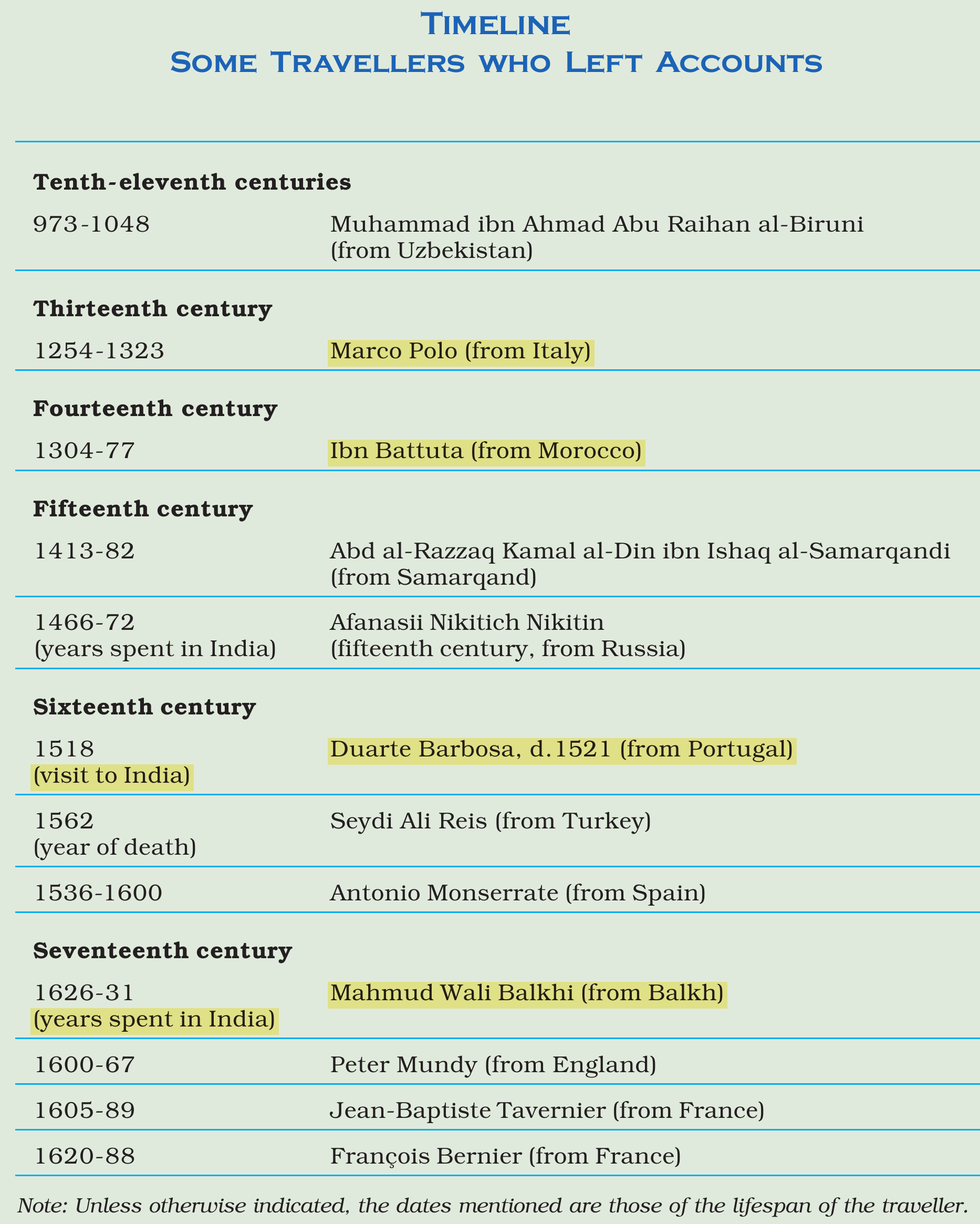
Arrange the following foreign travellers’ visit to India in a chronological manner:

(A) Mahmud Wali Balkhi
(B) Duarte Barbosa
(C) Ibn Battuta
(D) Marco Polo

Choose the correct answer from the options given below:

Answer & explanation+

Correct answer: option 2

The correct answer is Option (2) → (D), (C), (B), (A)

(D) Marco Polo — from Italy, thirteenth century (1254-1323).

(C) Ibn Battuta — from Morocco, fourteenth century (1304-77); he reached Sind in 1333.

(B) Duarte Barbosa — from Portugal, sixteenth century; he visited India in 1518.

(A) Mahmud Wali Balkhi — from Balkh, seventeenth century; he spent the years 1626-31 in India.


NCERT: Themes in Indian History Part II — Chapter 5: Through the Eyes of Travellers (2026-27)

NCERT extract

Advertisement

Practise more on Medieval India: Through the Eyes of Travellers

Chapter-wise mocks on the real NTA exam screen, with solutions and your rank. Your first mocks are free.

Start free mocks →

Advertisement

Next questions

  1. GDP at factor cost :Economics · Macro Economics: National Income Accounting
  2. Select the Venn diagram that best represents the relationship between the following classes. Doctors, Fathers, MothersGeneral Aptitude Test · Verbal Reasoning
  3. Select the option that expresses the given sentence in passive voice. The officers kept us waiting for one hour.English · Grammar: Active Passive Voice
  4. Disinvestment isSociology · Social Change and Development in India: Change and Development in industrial Society
  5. The maximum slope of curve y = -x^3 + 3x^2 + 9x - 27 isMaths. Section B1 · Applications of Derivatives
  6. The following ratios primarily measure risk: (A) Liquidity (B) Activity (C) Debts (D) Profitability Choose the correct answer from the opti…Accountancy Part B · Accounting Ratios
  7. Prithviraja III defeated Afghan ruler Sultan Muhammad Ghori in ______.General Aptitude Test · General Knowledge
  8. Organisms which can tolerate a wide range of temperature are called:Biology · Organisms and Populations
  9. The expression for threshold energy is given by which of the following?Chemistry · Physical: Chemical Kinetics
  10. Match the following. Item Major Head A) Provision for provident fund I) Contingent liabilities in notes to accounts B) Proposed dividend II…Accountancy Part B · Financial Statements of a Company