
In Clemmensen reduction carbonyl compound is treated with
Answer & explanation
Correct answer: option 1
The correct answer is Option (1) → Zinc amalgam + HCl
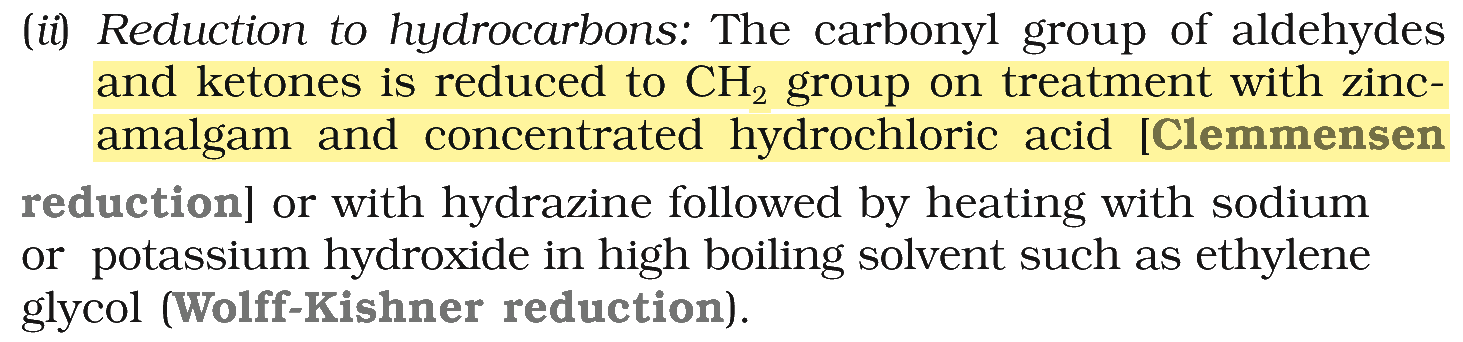
The carbonyl group of aldehydes and ketones can be reduced completely to a CH2 group, giving a hydrocarbon. There are two standard methods:
Clemmensen reduction: heating with zinc amalgam and concentrated hydrochloric acid (acidic conditions).
\( \displaystyle \ce{R2C=O} \xrightarrow{\text{Zn-Hg},\ \text{conc. }\ce{HCl}} \ce{R2CH2 + H2O} \)
Wolff–Kishner reduction: the hydrazone formed with hydrazine (\( \ce{NH2NH2} \)) is heated with KOH in ethylene glycol (basic conditions).
\( \displaystyle \ce{R2C=O + NH2NH2} \xrightarrow{-\ce{H2O}} \ce{R2C=NNH2} \xrightarrow[\text{heat}]{\ce{KOH}\text{, ethylene glycol}} \ce{R2CH2 + N2} \)
So in Clemmensen reduction the carbonyl compound is treated with zinc amalgam and HCl.
NCERT (2026-27 edition):
Reduction to Hydrocarbons
Note: The same/similar question has been asked in different years by NTA as per the details given below:
| 2026 | 2025 | 2024 | 2023 | 2022 |
|---|---|---|---|---|
| 25-05 S2 | 03-06 S2 15-05 S2 | – | – | – |