
A can complete a work in 60 days. B is 25% more efficient than A. They work together for 15 days. C alone completes the remaining work in 14 days. B and C together will complete $\frac{5}{8}$th part of the original work in:
Answer & explanation
Correct answer: option 4
A = 60 days,
A : B = 4 : 5,
Therefore,
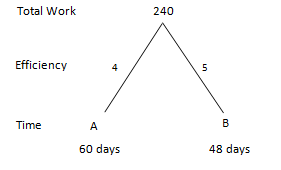
So, total efficiency of A + B = 9,
⇒ Work done in 15 days by A + B = 9 x 15 =135 units ..(Efficiency × Days = Total work)
⇒ Remaining work will be completed by C alone in 14 days = \(\frac{135}{C}\) = 14 days,
⇒ So, C in one day = 7.5
⇒ Time taken by B + C to complete \(\frac{5}{8}\)th part of original work = ( 240 x \(\frac{5}{8}\) = 150 units
⇒ \(\frac{150}{5 + 7.5}\) = \(\frac{150}{12.5}\) = 12 days.