


CUET Preparation Today
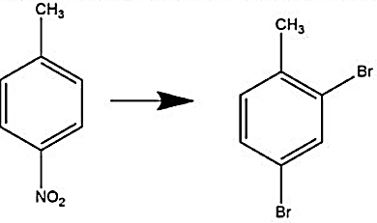
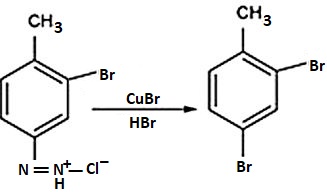
Predict the correct sequence of reagents to carry out the following conversion:
|
(i) $Cu_2Br_2/HBr$ (ii) $Sn/HCl$ (iii) $NaNO_2/HCl$ (iv) $Br_2/FeBr_3$ (i) $Br_2/FeBr_3$ (ii) $Sn/HCl$ (iii) $NaNO_2/HCl$ (iv) $Cu_2Br_2/HBr$ (i) $Br_2/FeBr_3$ (ii) $Sn/HCl$ (iii) $Cu_2Br_2/HBr$ (iv) $NaNO_2/HCl$ (i) $Sn/HCl$ (ii) $Br_2/FeBr_3$ (iii) $NaNO_2/HCl$ (iv) $Cu_2Br_2/HBr$ |
(i) $Br_2/FeBr_3$ (ii) $Sn/HCl$ (iii) $NaNO_2/HCl$ (iv) $Cu_2Br_2/HBr$ |
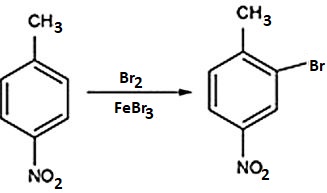
The correct answer is Option (2) → (i) $Br_2/FeBr_3$ (ii) $Sn/HCl$ (iii) $NaNO_2/HCl$ (iv) $Cu_2Br_2/HBr$ In the first step, we can see that when bromine and iron bromide react with 4-nitromethylbenzene, they substitute the hydrogen atoms from the ortho position to the methyl group with bromine. So, the product formed will be:
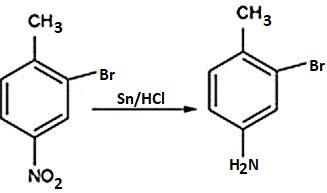
Now, when this mono-brominated product reacts with tin ($Sn$) in the presence of hydrochloric acid ($HCl$), it will reduce the nitro group to the amine group. As we know that in the reduction process, the addition of the hydrogen atom takes place by replacing the oxygen atom, so we will get:
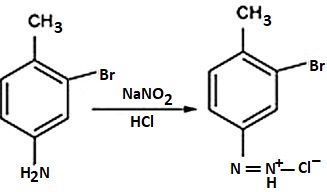
Now, the compound formed reacts with sodium nitrite ($NaNO_2$) in the presence of hydrochloric acid ($HCl$) to convert the amine group into a diazonium salt as shown:
Now, in the last step, the Gattermann reaction will take place, in which the formation of the aromatic ring takes place to produce halide benzene such as bromobenzene, chlorobenzene, etc. So, the final product formed will be:
|