Match List - I with List - II.
| List - I | List - II |
| (A) Marginal Propensity to Save | (I) \( \displaystyle\frac{\Delta Y}{\Delta I} \) |
| (B) Average Propensity to Consume | (II) \( \displaystyle\frac{\Delta S}{\Delta Y} \) |
| (C) Value of Investment Multiplier | (III) \( 1 - APS \) |
| (D) Marginal Propensity to Consume | (IV) \( \displaystyle\frac{\Delta C}{\Delta Y} \) |
Choose the correct answer from the options given below :
Answer & explanation
Correct answer: option 2
The correct answer is Option (2) → (A)-(II), (B)-(III), (C)-(I), (D)-(IV)
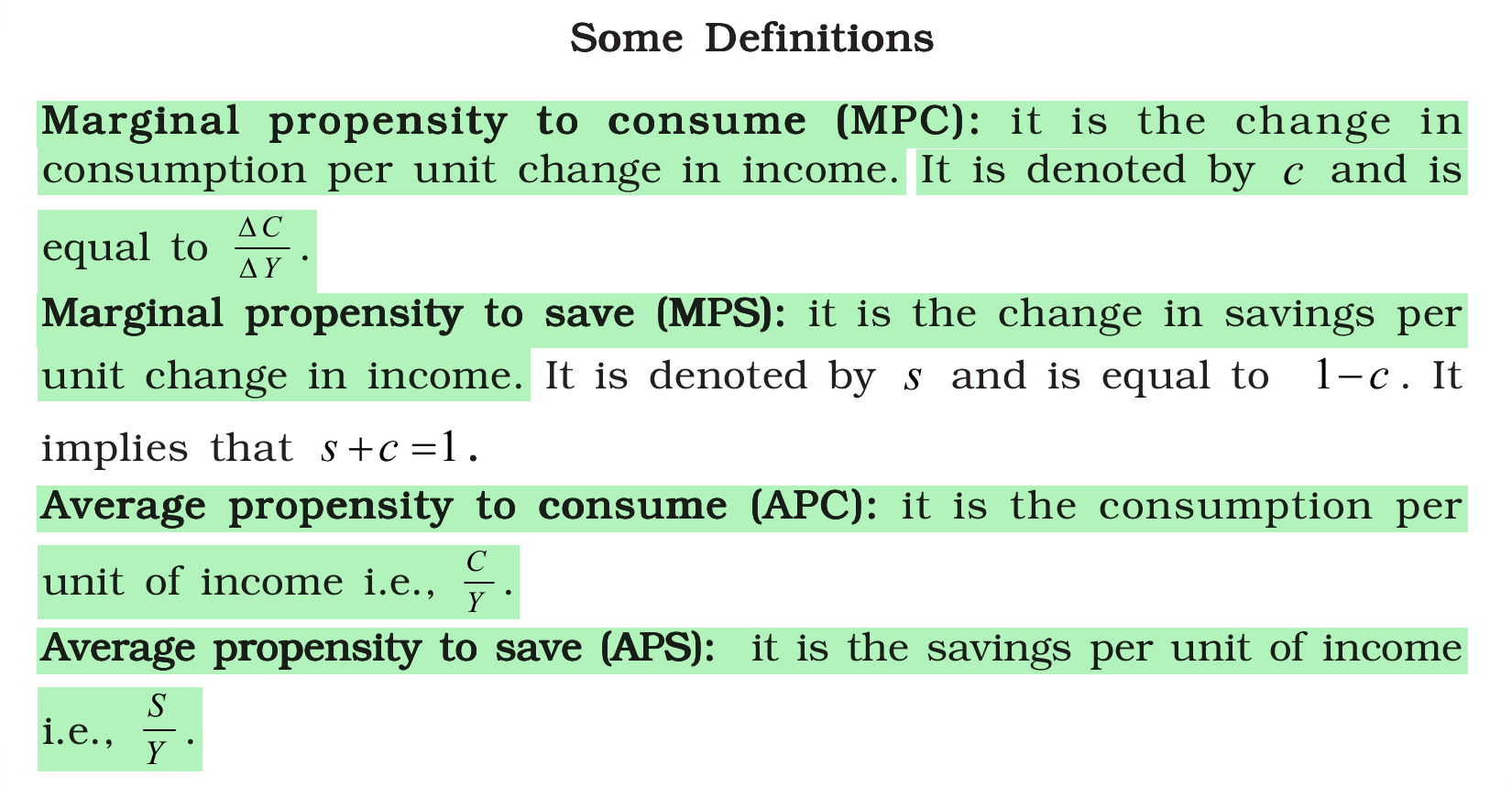
A propensity tells us how income is split between consumption and saving. An average propensity uses the totals. A marginal propensity uses the change when income changes.
| List-I | List-II | Reason |
|---|---|---|
| (A) Marginal Propensity to Save | (II) \( \displaystyle\frac{\Delta S}{\Delta Y} \) | It is the change in savings per unit change in income. |
| (B) Average Propensity to Consume | (III) \( 1 - APS \) | APC is C/Y and APS is S/Y. Income is either consumed or saved (C + S = Y), so APC + APS = 1. |
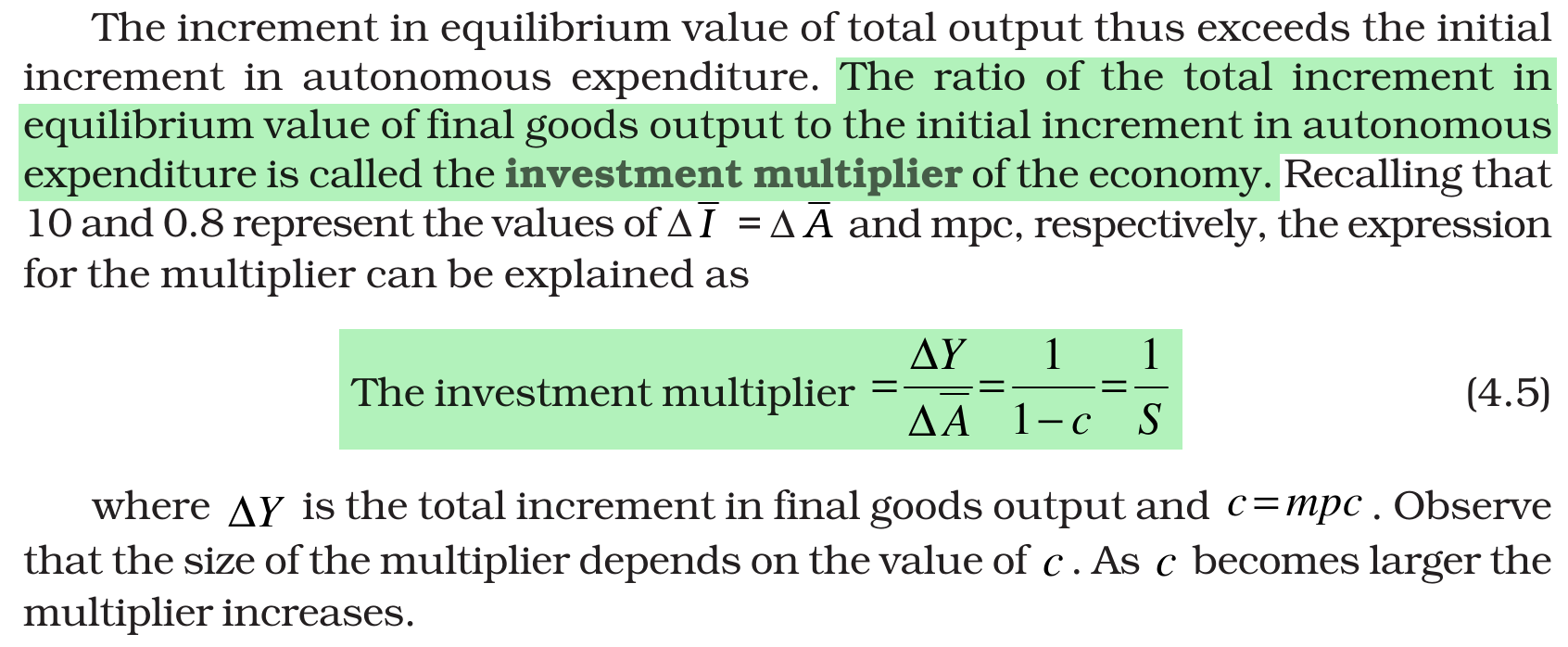
| (C) Value of Investment Multiplier | (I) \( \displaystyle\frac{\Delta Y}{\Delta I} \) | It is the total increase in output for each rupee of extra investment. |
| (D) Marginal Propensity to Consume | (IV) \( \displaystyle\frac{\Delta C}{\Delta Y} \) | It is the change in consumption per unit change in income. |
NCERT (2026-27): Introductory Macroeconomics — Chapter 4: Determination of Income and Employment
|