
Which of the following statements are correct?
A. Tertiary alcohols undergo oxidation reaction when heated with \(Cu\) at \(573\, \ K\).
B. Salicylic acid is 2-hydroxybenzoic acid
C. Ease of dehydration of alcohols is in the order primary > secondary > tertiary
D. Electrophile attacks at o- and p- position in anisole.
E. Aspirin is \(C_8H_8O_4\)
Choose the correct answer from the options given below:
Answer & explanation
Correct answer: option 1
The correct answer is Option (1) → B, D only
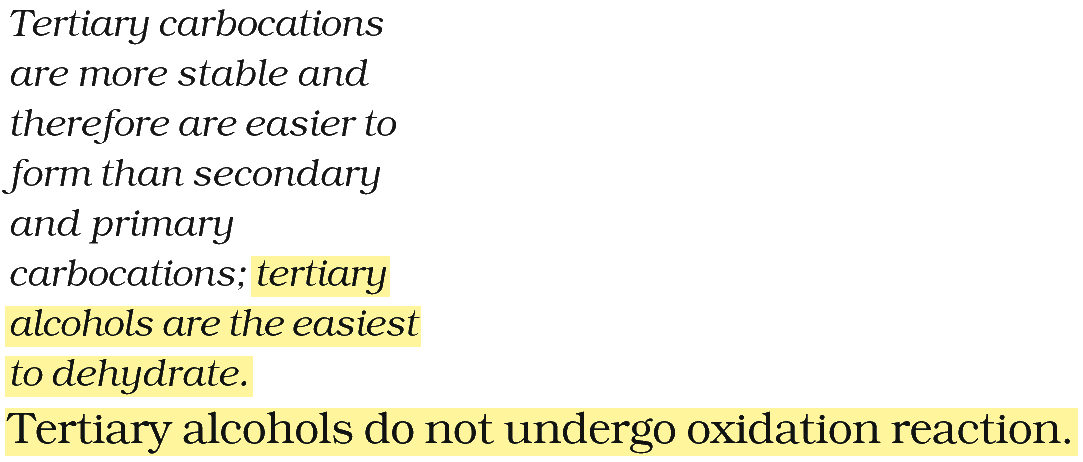
(A) Tertiary alcohols undergo oxidation reaction when heated with Cu at 573 K. — False. Primary and secondary alcohols are dehydrogenated on heated copper; a tertiary alcohol has no H on the carbinol carbon and is dehydrated to an alkene instead:
\( \ce{RCH2OH} \xrightarrow{\text{Cu, 573 K}} \ce{RCHO + H2} \) \( \ce{R2CHOH} \xrightarrow{\text{Cu, 573 K}} \ce{R2CO + H2} \)
\( \ce{(CH3)3COH} \xrightarrow{\text{Cu, 573 K}} \ce{(CH3)2C=CH2 + H2O} \)
(B) Salicylic acid is 2-hydroxybenzoic acid — True. It has –COOH and –OH on adjacent ring carbons (o-hydroxybenzoic acid).
(C) Ease of dehydration of alcohols is in the order primary > secondary > tertiary — False. Tertiary carbocations form most easily, so the order is tertiary > secondary > primary.
(D) Electrophile attacks at o- and p- position in anisole. — True. The –\( \ce{OCH3} \) group activates the ring and is ortho, para directing:
\( \ce{C6H5OCH3 + Br2} \xrightarrow{\text{ethanoic acid}} \text{o-/p-}\ce{BrC6H4OCH3 + HBr} \)
(E) Aspirin is C8H8O4 — False. Aspirin (acetylsalicylic acid, from acetylation of salicylic acid) is C9H8O4:
\( \ce{HOC6H4COOH + (CH3CO)2O} \xrightarrow{\ce{H+}} \ce{CH3COOC6H4COOH + CH3COOH} \)
NCERT (2026-27 edition):
Oxidation – …
“… The introduction of acetyl (CH3CO) group in alcohols or phenols is known as acetylation. Acetylation of salicylic acid produces aspirin.”