
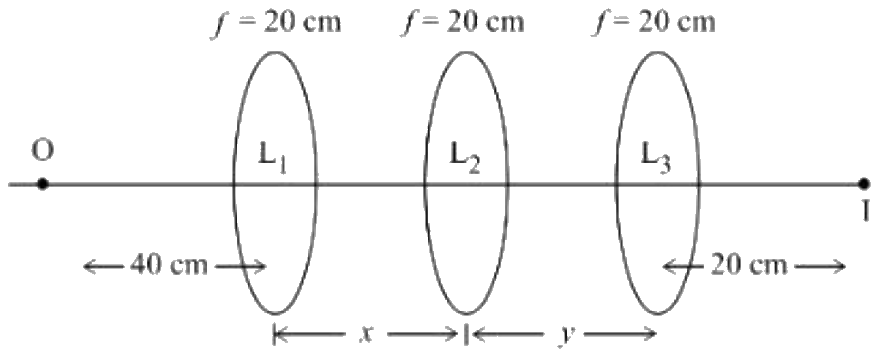
Three convex lenses each of focal length 20 cm are placed co-axially as shown in the figure. Object ‘O’ is placed in front of a lens \( L_1 \) at distance of 40 cm and final image by \( L_3 \) is formed at 20 cm from it, then distances \( x \) and \( y \) in the figure are
Answer & explanation
Correct answer: option 2
The correct answer is Option (2) → \( x \) = 60 cm, \( y \) = any value
Work backwards from the final image using the lens formula \( \frac{1}{v} - \frac{1}{u} = \frac{1}{f} \) (Cartesian sign convention, light travelling left to right).
The final image is 20 cm beyond \( L_3 \), that is at its focus. So the light falling on \( L_3 \) must be a parallel beam. A parallel beam leaves \( L_2 \) only if the object for \( L_2 \) is at the focus of \( L_2 \), 20 cm in front of it.
Image formed by \( L_1 \) (\( u = -40\,\mathrm{cm} \), \( f = +20\,\mathrm{cm} \)):
\( \displaystyle \frac{1}{v_1} = \frac{1}{f} + \frac{1}{u} = \frac{1}{20} - \frac{1}{40} = \frac{1}{40} \;\Rightarrow\; v_1 = 40\,\mathrm{cm} \)
This image must lie 20 cm in front of \( L_2 \):
\( x = 40\,\mathrm{cm} + 20\,\mathrm{cm} = 60\,\mathrm{cm} \)
The beam between \( L_2 \) and \( L_3 \) is parallel to the axis, so it reaches \( L_3 \) as a parallel beam whatever the separation. Hence \( y \) can have any value.