


CUET Preparation Today
A dietician wishes to mix two kinds of food X and Y in such a way that the mixture contains atleast 10 units of vitamin A, 12 units of vitamin B and 8 units of vitamin C. The vitamin contents of one kg food is given below:
One kg of food X costs ₹24 and one kg of food Y costs ₹36. Using linear programming, find the least cost of the total mixture which will contain the required vitamins. |
₹192 ₹204 ₹187 ₹196 |
₹192 |
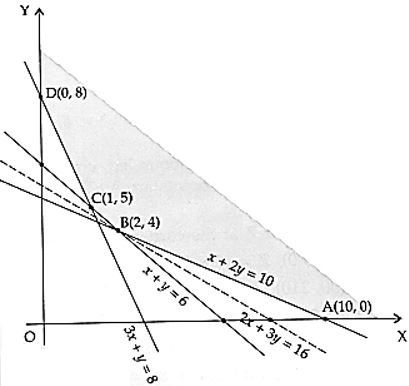
The correct answer is Option (1) → ₹192 Let x kg of food X and y kg of food Y be mixed and Z (in ₹) be the total cost of the (mixture) food, then the problem can be formulated as an L.P.P. as follows: Minimise $Z = 24x + 36y$ subject to the constraints $x + 2y ≥ 10$ (vitamin A constraint) $2x + 2y ≥ 12$ i.e. $x + y ≥6$ (vitamin B constraint) $3x + y ≥ 8$ (vitamin C constraint) $x ≥0, y ≥0$ (Non-negativity constraints) To solve this L.P.P. graphically, we draw the lines $x + 2y = 10$ ...(i) $x + y = 6$ ...(ii) $3x + y = 8$ ...(iii) The feasible region (unbounded, convex) is shown shaded in the figure given below. The corner points are A(10, 0), B(2, 4), C(1, 5) and D(0, 8). The values of Z (in ₹) = $24x + 36y$ at the corner points are: at $A(10, 0), Z = 24 × 10 + 36 × 0 = 240;$ at $B (2, 4), Z = 24 × 2 + 36 × 4 = 192;$ at $C(1, 4), Z = 24 × 1 + 36 × 5 = 204;$ at $D(0, 8), Z = 24 × 0 + 36 × 8 = 288;$ Among these values of Z, the minimum value is 192.
We draw the line $24x + 36y= 192$ i.e. $2x + 3y = 16$ (shown dotted) and note that the half plane $2x + 3y < 16$ has no common point with the feasible region, therefore, Z has minimum value. The minimum value of Z is ₹192 and it occurs at the point B(2, 4). Hence, the least cost of the mixture ₹192 when the dietician mixes is 192 kg of food X and 4 kg of food Y. |