
Case: Read the passage and answer the question.
Consider a coil \( C_1 \) connected to a galvanometer G as shown in the figure. Another current-carrying coil \( C_2 \) is placed next to the first coil.
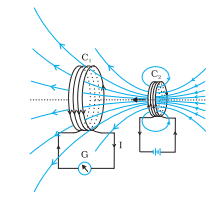
What happens when \( C_1 \) and \( C_2 \) are moved away from each other along the x-axis?
Answer & explanation
Correct answer: option 1
The correct answer is Option (1) → A current is induced in \( C_1 \), opposite in direction to the current induced when the coils approach each other
By Faraday’s law, a current is induced in \( C_1 \) only while the magnetic flux through it changes. By Lenz’s law, the induced current always opposes that change.
Option (1) A current is induced in \( C_1 \), opposite in direction to the current induced when the coils approach each other — Correct. Moving the coils apart decreases the flux of \( C_2 \) through \( C_1 \), while bringing them together increases it. The induced current opposes each change, so the two currents flow in opposite directions.
Option (2) A current is induced in \( C_1 \), in the same direction as when the coils approach each other — Incorrect. The same direction would need the flux through \( C_1 \) to change in the same sense both times. But the flux increases on approach and decreases on separation.
Option (3) No current flows at all — Incorrect. The coils are in relative motion, so the flux through \( C_1 \) changes and an emf is induced. A current flows while the motion lasts.
Option (4) The galvanometer keeps a steady deflection even after the coils stop — Incorrect. Once the coils stop, the flux through \( C_1 \) is constant, the induced emf is zero and the pointer returns to zero.
NCERT (2026-27):
The Experiments of Faraday and Henry – “… The steady current in the coil C2 produces a steady magnetic field. As coil C2 is moved towards the coil C1, the galvanometer shows a deflection. This indicates that electric current is induced in coil C1. When C2 is moved away, the galvanometer shows a deflection again, but this time in the opposite direction. The deflection lasts as long as coil C2 is in motion. When the coil C2 is held fixed and C1 is moved, the same effects are observed.”