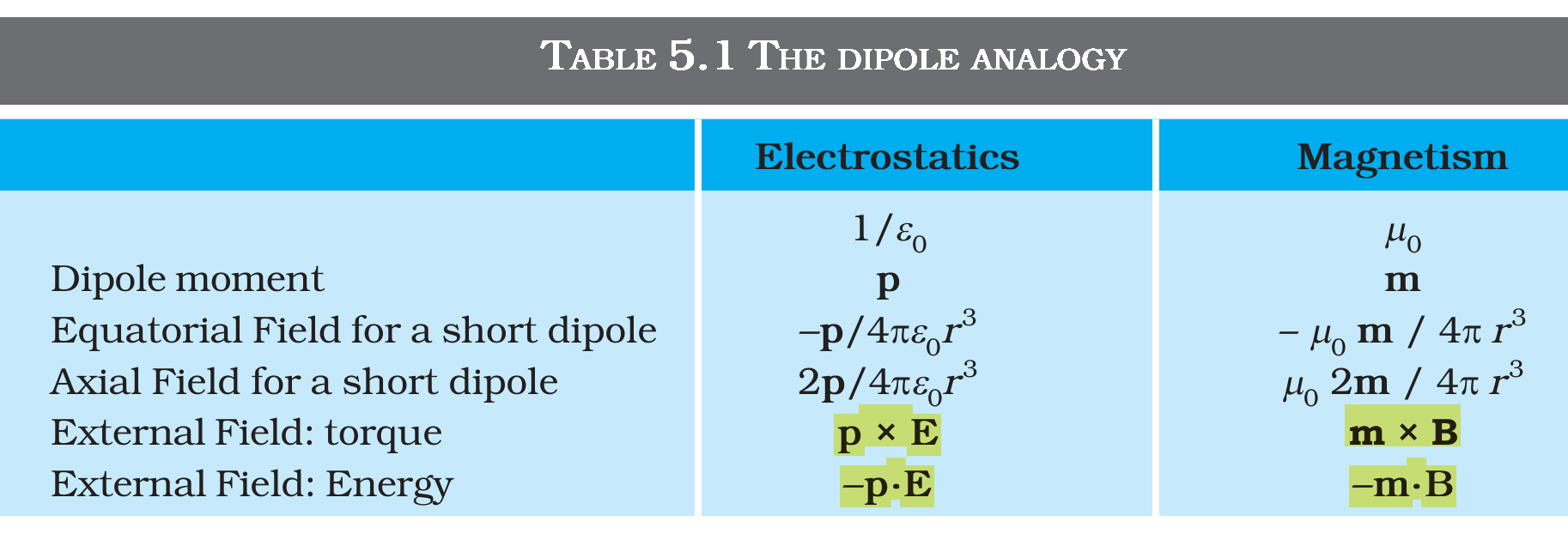
List-I gives some quantities for a magnetic dipole. List-II gives quantities for an electric dipole. Match each magnetic quantity in List-I with the matching electric quantity in List-II.
| List-I | List-II |
|---|---|
| (A) Magnetic dipole moment \(\mathbf{m}\) | (I) \(-\mathbf{p}\cdot\mathbf{E}\) |
| (B) The constant \(\mu_0\) | (II) \(\mathbf{p}\) |
| (C) Torque on the dipole in a uniform field | (III) \(1/\varepsilon_0\) |
| (D) Potential energy of the dipole in a uniform field | (IV) \(\mathbf{p}\times\mathbf{E}\) |
Choose the correct answer from the options given below:
Answer & explanation
Correct answer: option 4
The correct answer is Option (4) → (A)-(II), (B)-(III), (C)-(IV), (D)-(I)
(A) Magnetic dipole moment \( \mathbf{m} \) — This matches (II) \( \mathbf{p} \). A bar magnet of moment \( \mathbf{m} \) behaves like an electric dipole of moment \( \mathbf{p} \).
(B) The constant \( \mu_0 \) — This matches (III) \( 1/\varepsilon_0 \). In the dipole formulas, \( 1/4\pi\varepsilon_0 \) is replaced by \( \mu_0/4\pi \).
(C) Torque on the dipole in a uniform field — This matches (IV) \( \mathbf{p}\times\mathbf{E} \). The torque on a magnet is \( \mathbf{m}\times\mathbf{B} \), a cross product of the same form.
(D) Potential energy of the dipole in a uniform field — This matches (I) \( -\mathbf{p}\cdot\mathbf{E} \). The energy of a magnet is \( -\mathbf{m}\cdot\mathbf{B} \), a dot product with a minus sign.
NCERT (2026-27):
The electrostatic analog – “… magnetic field at large distances due to a bar magnet of magnetic moment m can be obtained from the equation for electric field due to an electric dipole of dipole moment p, by making the following replacements:”
\( \mathbf{E}\rightarrow\mathbf{B}, \) \( \mathbf{p}\rightarrow\mathbf{m} \), \( \displaystyle \frac{1}{4\pi\varepsilon_0}\rightarrow\frac{\mu_0}{4\pi} \)
The electrostatic analog – “… Table 5.1 summarises the analogy between electric and magnetic dipoles.”