
How are adjacent nucleotides joined together in a nucleic acid chain?
Answer & explanation
Correct answer: option 4
The correct answer is Option (4) → Phosphodiester linkage
A nucleic acid is a chain of nucleotides (base + pentose sugar + phosphate). The phosphate group links the 5′ carbon of one sugar to the 3′ carbon of the next, forming an ester bond on each side of the phosphorus: a phosphodiester linkage.
Why the other options are incorrect
Option (1) Glycosidic linkage — Incorrect. A glycosidic linkage joins monosaccharide units through an oxygen atom in disaccharides and polysaccharides; it does not join nucleotides.
Option (2) Ionic bond — Incorrect. The nucleotides are joined by covalent ester bonds through phosphate, not by attraction between ions.
Option (3) Peptide bond — Incorrect. A peptide bond (–CO–NH–) joins amino acids in proteins.
NCERT (2026-27 edition):
10.5.2 Structure of Nucleic Acids – “Nucleotides are joined together by phosphodiester linkage between 5′ and 3′ carbon atoms of the pentose sugar. The formation of a typical dinucleotide is shown in Fig. 10.6.”
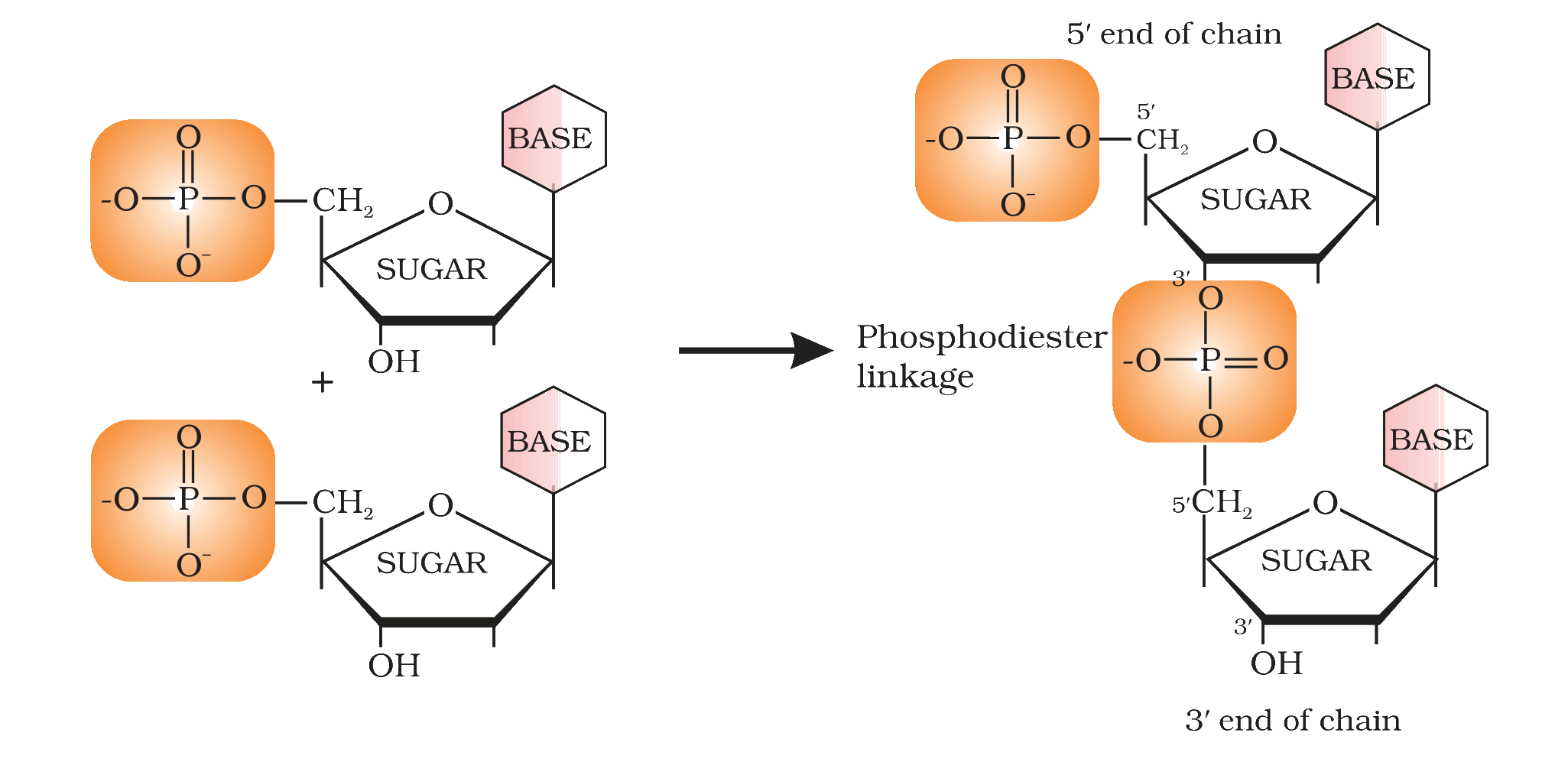
Fig. 10.6: Formation of a dinucleotide