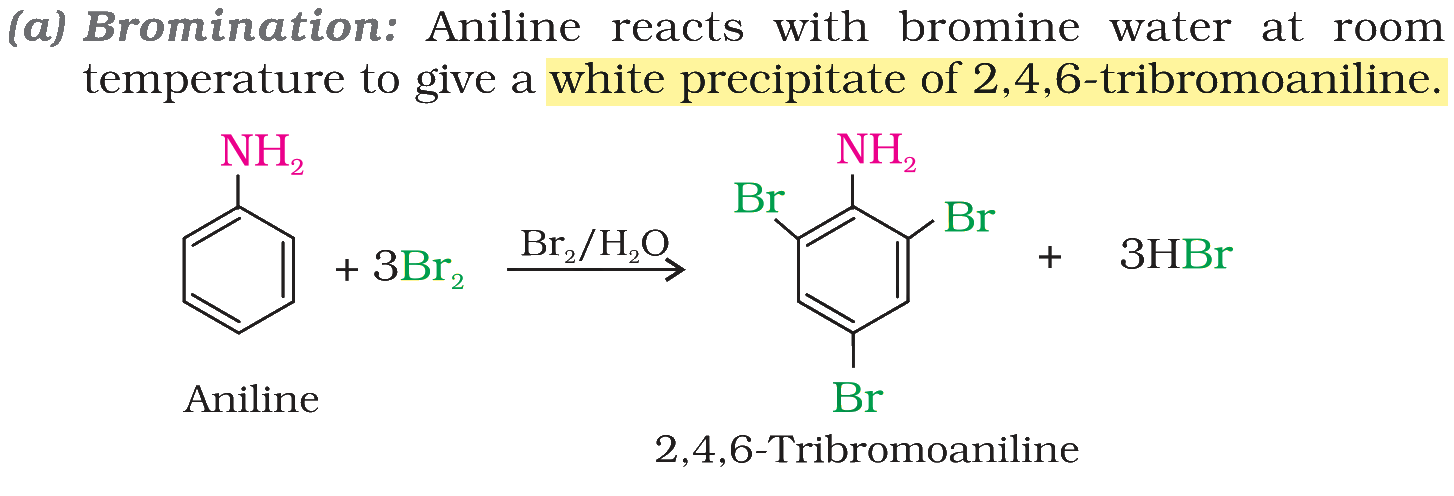
Aniline reacts with bromine water at room temperature and forms a compound X. Identify X.
Answer & explanation
Correct answer: option 3
The correct answer is Option (3) → 2,4,6-tribromoaniline
The –\( \ce{NH2} \) group of aniline donates its lone pair into the ring by resonance, so the ortho and para positions become centres of high electron density. It is a powerful activating, ortho/para directing group. The ring is so reactive that bromine water brominates it at room temperature without any catalyst, and the substitution does not stop after one bromine: all three ortho and para positions are substituted.
\( \displaystyle \ce{C6H5NH2 + 3Br2} \xrightarrow[\text{room temp.}]{\ce{H2O}} \ce{C6H2Br3NH2 v + 3HBr} \)
So X, obtained as a white precipitate, is 2,4,6-tribromoaniline.
Why the other options are incorrect
Option (1) 2-Bromoaniline — Incorrect. The strongly activated ring does not stop at one bromine; the other ortho and the para positions are brominated as well.
Option (2) 4-Bromoaniline — Incorrect. It becomes the main product only when the activating effect of –\( \ce{NH2} \) is first reduced by acetylation. Aniline is converted into acetanilide, which is brominated at the para position, and the acetyl group is then removed by hydrolysis:
\( \displaystyle \ce{C6H5NH2 + (CH3CO)2O -> C6H5NHCOCH3 + CH3COOH} \)
\( \displaystyle \ce{C6H5NHCOCH3 + Br2} \xrightarrow{\ce{CH3COOH}} p\text{-}\ce{BrC6H4NHCOCH3 + HBr} \)
\( \displaystyle p\text{-}\ce{BrC6H4NHCOCH3 + H2O} \xrightarrow{\ce{H+}\ \text{or}\ \ce{OH-}} p\text{-}\ce{BrC6H4NH2 + CH3COOH} \)
Option (4) 2-Bromoaniline and 4-Bromoaniline — Incorrect. A mixture of monobromo products would need a less activated ring; with bromine water each aniline molecule takes up three bromine atoms.
NCERT (2026-27 edition):
Electrophilic Substitution – …