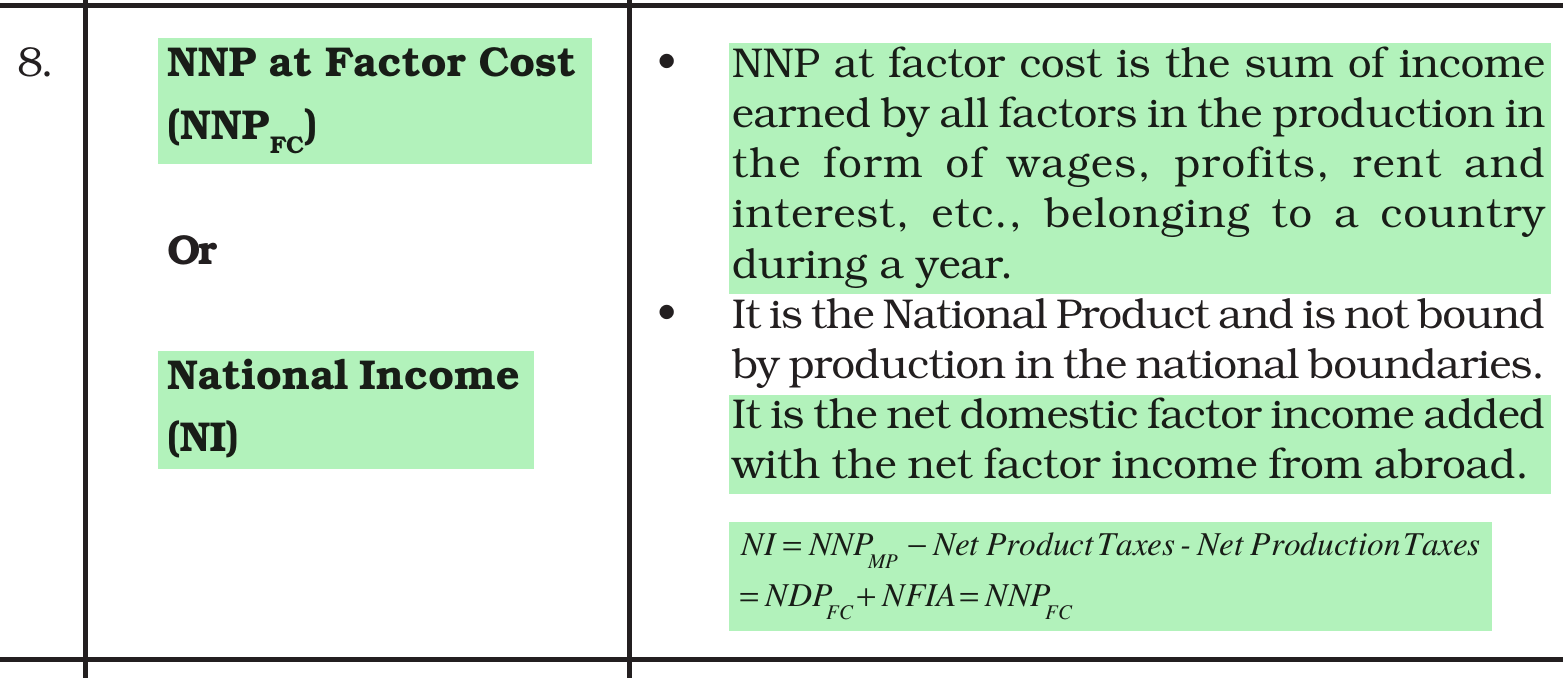
Which of the following are true about national income and related aggregates?
(A) National income includes factor income earned from abroad but does not include factor income paid abroad.
(B) Domestic income does not include factor income earned from abroad but includes factor income paid to abroad.
(C) Domestic income includes both factor income earned from abroad and factor income paid to abroad
(D) National income can never be smaller than domestic income.
Choose the correct answer from the options given below:
Answer & explanation
Correct answer: option 1
The correct answer is Option (1) → (A) and (B) only
Domestic income is the income earned inside the country, whoever earns it. It is also called net domestic product at factor cost (NDP at factor cost). National income is the income earned by the country’s own factors of production, wherever they work.
National income = Domestic income + Net factor income from abroad
Net factor income from abroad = Factor income earned from abroad − Factor income paid abroad
(A) National income includes factor income earned from abroad but does not include factor income paid abroad. — True. Income earned abroad by the country’s factors is added. Income paid to foreign factors working here is taken out.
(B) Domestic income does not include factor income earned from abroad but includes factor income paid to abroad. — True. Income earned abroad arises outside the country, so it is left out. Income paid to foreign factors arises inside the country, so it is counted.
(C) Domestic income includes both factor income earned from abroad and factor income paid to abroad — False. Factor income earned from abroad arises outside the country, so domestic income does not include it.
(D) National income can never be smaller than domestic income. — False. If more is paid abroad than is earned from abroad, net factor income from abroad is negative. National income is then smaller than domestic income.
NCERT (2026-27): “2.3 Some Macroeconomic Identities Gross Domestic Product measures the aggregate production of final goods and services taking place within the domestic economy during a year. But the whole of it may not accrue to the citizens of the country. For example, a citizen of India working in Saudi Arabia may be earning her wage and it will be included in the Saudi Arabian GDP. But legally speaking, she is an Indian. … When we try to do this, in order to maintain symmetry, we must deduct the earnings of the foreigners who are working within our domestic economy, or the payments to the factors of production owned by the foreigners. For example, the profits earned by the Korean-owned Hyundai car factory will have to be subtracted from the GDP of India. The macroeconomic variable which takes into account such additions and subtractions is known as Gross National Product (GNP). It is, therefore, defined as follows Hence, GNP ≡ GDP + Net factor income from abroad (Net factor income from abroad = Factor income earned by the domestic factors of production employed in the rest of the world – Factor income earned by the factors of production of the rest of the world employed in the domestic economy).…” NCERT (2026-27): Introductory Macroeconomics — Chapter 2: National Income Accounting, Table 2.4 (row 4)
NCERT (2026-27): Introductory Macroeconomics — Chapter 2: National Income Accounting, Table 2.4 (row 8)
|