Arrange the following in order of increasing boiling points
(A) 1,4-Dichlorobenzene
(B) 1,3-Dichlorobenzene
(C) 1,2-Dichlorobenzene
(D) Chlorobenzene
Choose the correct answer from the options given below:
Answer & explanation
Correct answer: option 1
The correct answer is Option (1) → (D), (B), (A), (C)
Note: NTA dropped this question in the official Answer Key. However, to provide additional question practice to the students, the question has been slightly modified so that the question has one clear answer.
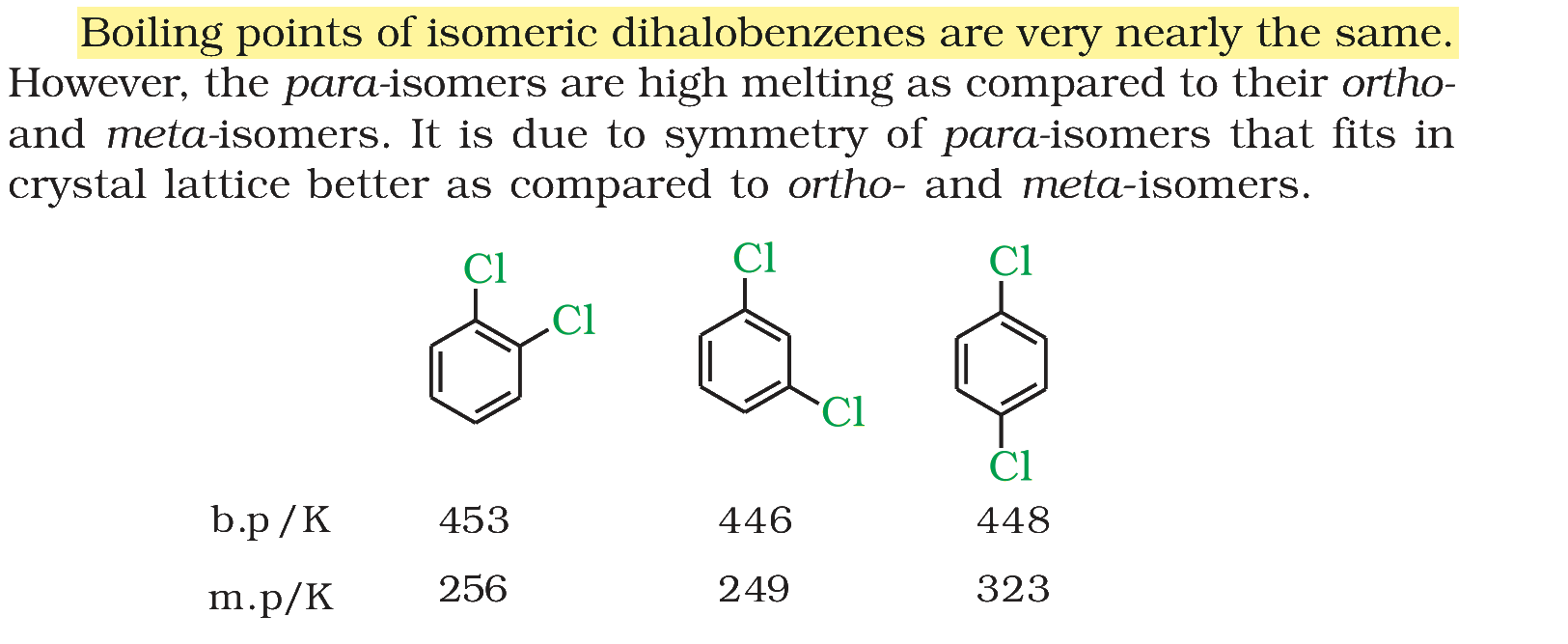
Chlorobenzene and the dichlorobenzenes cannot form hydrogen bonds, so their boiling points depend on the van der Waals forces between the molecules. These forces grow with molecular mass and size, and, among isomers of the same mass, they are slightly stronger for the more polar isomer.
(D) Chlorobenzene, \( \ce{C6H5Cl} \) (molar mass 112.5 g mol−1): the smallest molecule, so it has the lowest boiling point, about 405 K.
(A), (B), (C) The three dichlorobenzenes, \( \ce{C6H4Cl2} \) (molar mass 147 g mol−1 each), boil well above chlorobenzene. Being isomers, their boiling points are very nearly the same (values in the extract): meta lowest, then para, then ortho. The ortho isomer, with the two C–Cl bonds on the same side of the ring, has the largest dipole moment and the highest boiling point.
NCERT (2026-27 edition):
Physical Properties – …