
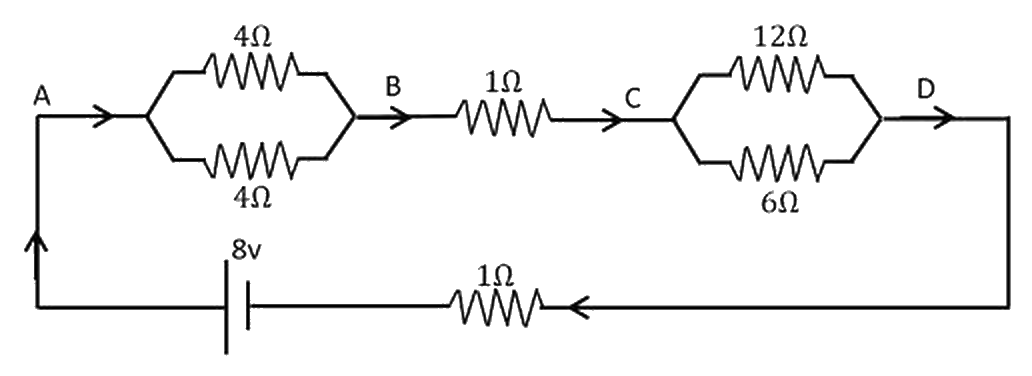
A network of resistors is connected as shown in the figure. The potential drop across 4 Ω resistors is
Answer & explanation
Correct answer: option 1
The correct answer is Option (1) → \( 2\,\mathrm{V} \)
Find the total resistance of the loop by reducing the parallel and series groups, take the current from Ohm's law, and then split it between the two \( 4\,\Omega \) resistors. The cell is taken as ideal; the \( 1\,\Omega \) resistor next to it is a separate resistor in the loop.
Between A and B, two equal \( 4\,\Omega \) resistors are in parallel:
\( \displaystyle R_{AB} = \frac{4 \times 4}{4 + 4} = 2\,\Omega \)
Between C and D, \( 12\,\Omega \) and \( 6\,\Omega \) are in parallel:
\( \displaystyle R_{CD} = \frac{12 \times 6}{12 + 6} = 4\,\Omega \)
These are in series with the two \( 1\,\Omega \) resistors:
\( \displaystyle R_{\mathrm{total}} = 2 + 1 + 4 + 1 = 8\,\Omega \)
\( \displaystyle I = \frac{V}{R_{\mathrm{total}}} = \frac{8}{8} = 1\,\mathrm{A} \)
The two equal \( 4\,\Omega \) resistors share this current equally, so each carries \( 0.5\,\mathrm{A} \).
\( \displaystyle V_{4\,\Omega} = 0.5 \times 4 = 2\,\mathrm{V} \)
Equivalently, the drop across the parallel pair is \( I\,R_{AB} = 1 \times 2 = 2\,\mathrm{V} \), and the same voltage is across each \( 4\,\Omega \) resistor.