Which of the following part is not related to the structure of the ‘stupa’?
Answer & explanation
Correct answer: option 4
The correct answer is Option (4) → Tathagata
The stupa began as a simple semi-circular mound of earth and slowly grew into a more complex structure. The question asks which option is not one of its parts.
Option (1) Anda — A part of the stupa (Incorrect). The anda is the hemispherical mound itself, the oldest and central part of the stupa.
Option (2) Harmika — A part of the stupa (Incorrect). The harmika is the balcony-like structure above the anda, which represented the abode of the gods.
Option (3) Yashti — A part of the stupa (Incorrect). The yashti is the mast arising from the harmika, often topped by a chhatri or umbrella.
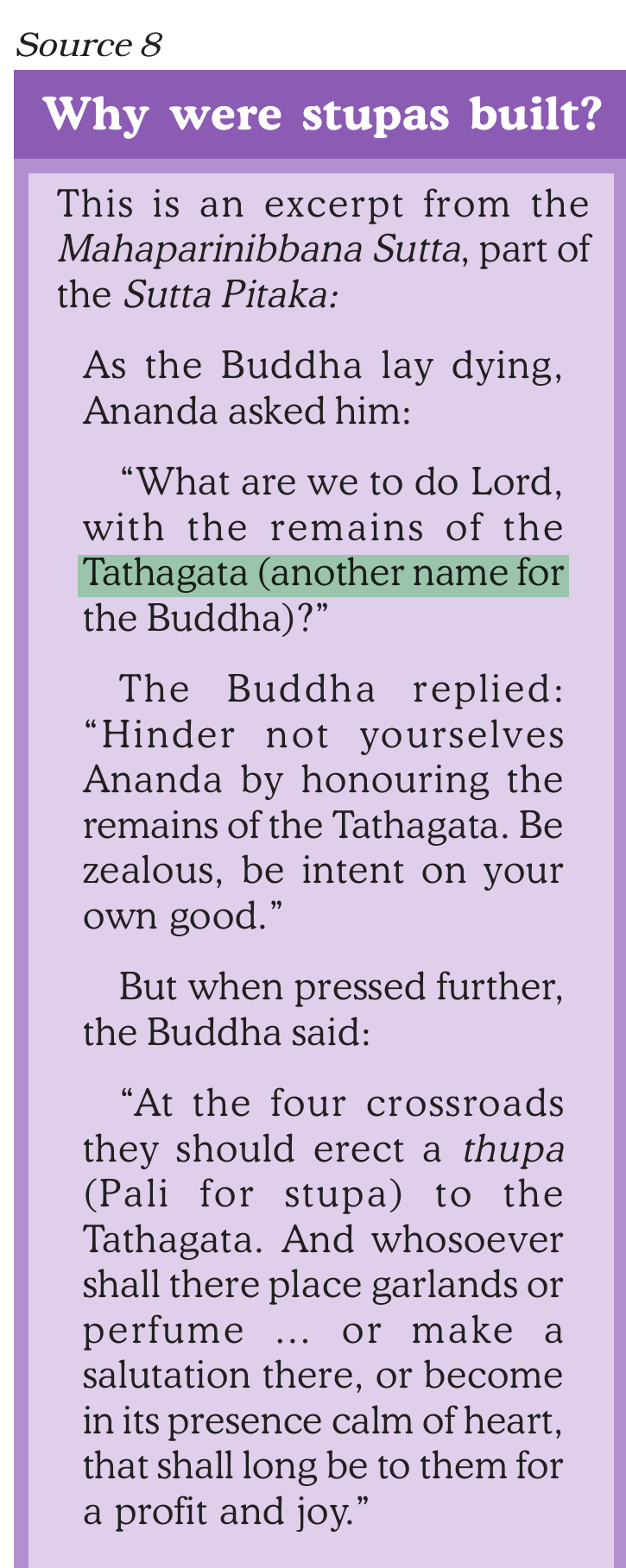
Option (4) Tathagata — Not a part of the stupa (Correct). Tathagata is another name for the Buddha, not a part of the building. It appears in the account of the Buddha’s last days, when Ananda asked him what should be done with the remains of the Tathagata.
NCERT (2025-26): “7.3 The structure of the stupa … The stupa (a Sanskrit word meaning a heap) originated as a simple semi-circular mound of earth, later called anda. Gradually, it evolved into a more complex structure, balancing round and square shapes. Above the anda was the harmika, a balcony-like structure that represented the abode of the gods. Arising from the harmika was a mast called the yashti, often surmounted by a chhatri or umbrella. Around the mound was a railing, separating the sacred space from the secular world.…”
|