
Case: Read the passage and answer the question.
Two spherical cavities A and B, of radii y and x respectively, are hollowed out from the interior of a conducting sphere of radius R. Charges \( q_1 \) and \( q_2 \) are placed at the centres of cavities A and B respectively. The situation is shown in the figure.
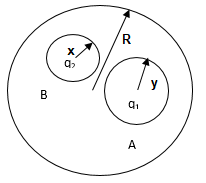
Which of the following is true if a third charge is placed near the conductor?
Answer & explanation
Correct answer: option 1
The correct answer is Option (1) → The charge distribution on the outer surface of the conductor will change.
In the static situation the electric field is zero inside the material of a conductor. Charges brought near the conductor induce charges only on its outer surface. A cavity inside a conductor is shielded from outside electrical influences.
Option (1) The charge distribution on the outer surface of the conductor will change. — Correct. The free electrons of the conductor shift under the force of the third charge. So the charges on the outer surface move to new positions until the field in the material is zero again. The total charge on the outer surface stays the same; only its distribution changes.
Option (2) The electric field inside the cavities will change. — Incorrect. The conductor around each cavity shields it from outside. The field in cavity A is still set up only by \( q_1 \) and the charge on its wall. In cavity B it is set up only by \( q_2 \) and the charge on its wall.
Option (3) The electric field inside the material of the conductor will change. — Incorrect. The field inside the material is zero before and after the third charge is brought near. The charges on the outer surface shift to keep it zero.
Option (4) The charge on the walls of the cavities will change. — Incorrect. Take a closed surface inside the material around a cavity. The field on it is zero, so by Gauss’s law it encloses no net charge. So the wall of cavity A carries \( -q_1 \) and the wall of cavity B carries \( -q_2 \). These depend only on the charges inside the cavities.
NCERT (2026-27):
Electrostatics of Conductors – “… A related result is that even if the conductor is charged or charges are induced on a neutral conductor by an external field, all charges reside only on the outer surface of a conductor with cavity.”
Points to Ponder – “7. A cavity inside a conductor is shielded from outside electrical influences.”