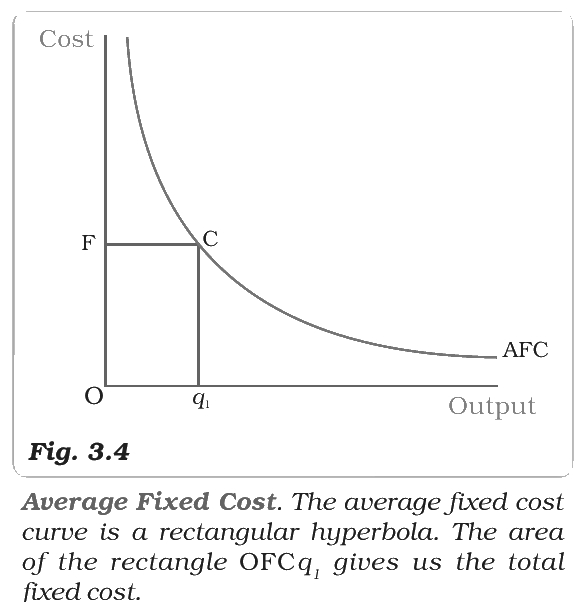
Consider the following statements about average fixed cost (AFC):
(A) AFC is total fixed cost divided by output.
(B) AFC falls as output rises.
(C) The AFC curve is a rectangular hyperbola.
(D) The AFC curve is ‘U’-shaped, like the AVC curve.
(E) Multiplying any level of output by its AFC always gives the same value.
Choose the correct answer from the options given below:
Answer & explanation
Correct answer: option 3
The correct answer is Option (3) → (A), (B), (C) and (E) only
(A) AFC is total fixed cost divided by output. — Correct. AFC = TFC/q.
(B) AFC falls as output rises. — Correct. TFC is fixed, so a larger output means a smaller share per unit.
(C) The AFC curve is a rectangular hyperbola. — Correct. AFC × q always equals TFC, which gives this shape.
(D) The AFC curve is ‘U’-shaped, like the AVC curve. — Incorrect. The AFC curve keeps falling as output rises; it never turns up like the AVC curve.
(E) Multiplying any level of output by its AFC always gives the same value. — Correct. The product is always the TFC.
NCERT (2026-27): “Shapes of the Short Run Cost Curves … AFC is the ratio of TFC to q. TFC is a constant. Therefore, as q increases, AFC decreases. When output is very close to zero, AFC is arbitrarily large, and as output moves towards infinity, AFC moves towards zero. AFC curve is, in fact, a rectangular hyperbola. If we multiply any value q of output with its corresponding AFC, we always get a constant, namely TFC.” “Summary … Total cost is the sum of total variable cost and the total fixed cost.
|