CUETMOCK
  • Pricing
  • Mentors
Log inStart freeStart free mocks→

First test, then trust

Try a free CUET mock test.

Join 5,00,000+ students who rehearsed exam day on the exact NTA screen before sitting CUET. On the web and on Android.

Start free mocks →Get the Android app
CUETMOCK

India's #1 CUET Mock Test Platform. Original NCERT-based questions on the exact NTA exam screen — trusted by 5,00,000+ students since CUET 2022.

Get it onGoogle PlayScan to download the CUETMOCK app

Mock tests

  • CUET mock test series
  • Browse all papers
  • Commerce mocks
  • Humanities (Arts) mocks
  • Science mocks
  • Languages & GAT mocks
  • Free practice questions
  • Pricing

Resources

  • CUET exam guide
  • CUET syllabus
  • Universities accepting CUET
  • Expert blogs
  • News & notifications
  • Webinars & counselling
  • CUET score calculator
  • How we estimate your rank
  • FAQs

Company

  • About us
  • Our leadership & team
  • Our toppers
  • Mentors
  • For schools
  • Contact us
  • Terms
  • Privacy
  • Refund policy

Talk to us

+91 7696 6630 56info@cuetmock.comWhatsApp us

Our other platforms

  • JEE Mock — For IIT-JEE aspirants
  • NEET Mock — For NEET aspirants

Newsletter

Exam updates, study material and offers — no spam.

© 2026 NYC Ventures Pvt. Ltd.

701-702, Royal Business Park, Zirakpur, Punjab - 140603

  • Terms of use
  • Privacy policy
  • Refund policy
  • Contact us

iCUETMOCK is an independent preparation platform, not affiliated with the National Testing Agency (NTA). Always check exam details on the official NTA website.

  • Home
  • Mock tests
  • CUET guide
  • Pricing
  • Log in
Home/Practice questions/History
HistoryModern India: Rebels and the Raj

Why did the soldiers object to the use of new cartridges and muskets?

Read the passage and answer the questions:

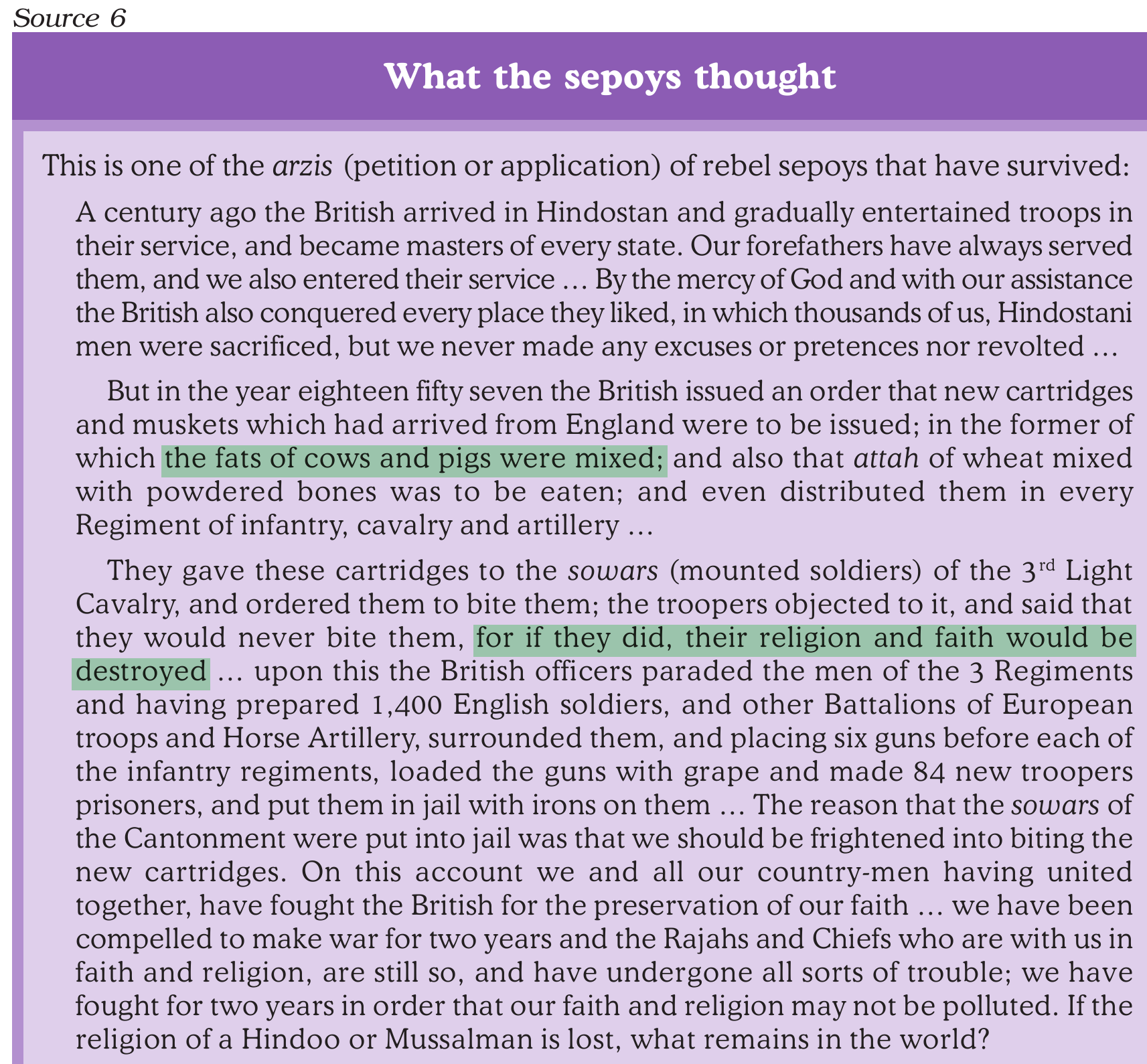
What the Sepoys Thought

A century ago the British arrived in Hindostan and gradually entertained troops in their service, and became masters of every state. Our forefathers have always served them, and we also entered their service … By the mercy of God and with our assistance the British also conquered every place they liked, in which thousands of us, Hindostani men were sacrificed, but we never made any excuses or pretences nor revolted … But in the year eighteen fifty-seven the British issued an order that new cartridges and muskets which had arrived from England were to be issued; in the former of which the fats of cows and pigs were mixed; and also that attah of wheat mixed with powdered bones was to be eaten; and even distributed them in every Regiment of infantry, cavalry and artillery … They gave these cartridges to the sowars (mounted soldiers) of the 3rd Light Cavalry, and ordered them to bite them; the troopers objected to it, and said that they would never bite them, for if they did, their religion and faith would be destroyed … upon this the British officers paraded the men of the 3 Regiments and having prepared 1,400 English soldiers, and other Battalions of European troops and Horse Artillery, surrounded them, and placing six guns before each of the infantry regiments, loaded the guns with grape and made 84 new troopers prisoners, and put them in jail with irons on them … The reason that the sowars of the Cantonment were put into jail was that we should be frightened into biting the new cartridges. On this account, we and all our country-men, having united together, have fought the British for the preservation of our faith.

Why did the soldiers object to the use of new cartridges and muskets?

Answer & explanation+

Correct answer: option 3

The correct answer is Option (3) → Due to the use of animal fats in ammunition as it aimed to destroy the faith of Indian soldiers

The sepoys say that the new cartridges had the fats of cows and pigs mixed in them. They were ordered to bite the cartridges, and they refused, because their religion and faith would be destroyed if they did. The passage ends by saying that they fought the British for the preservation of their faith.

Note: This passage is taken from the NCERT chapter ‘Rebels and the Raj’, where it is printed as a source, one of the arzis (petitions) of the rebel sepoys. Read the sources in every chapter as closely as the main text; whole passages of the paper are lifted from them.


NCERT: Themes in Indian History Part III — Chapter 10: Rebels and the Raj (2025-26)

NCERT extract

Advertisement

Practise more on Modern India: Rebels and the Raj

Chapter-wise mocks on the real NTA exam screen, with solutions and your rank. Your first mocks are free.

Start free mocks →

Advertisement

Next questions

  1. Fill in the blanks given in List-I with the correct words given in List-II.List-I (Sentences)List-II (Determiners)(A) The lab assistant sai…English · Grammar: Determiner
  2. Choose the correct passive form of the given sentence:The college canteen does not accept online payments on Sundays.English · Grammar: Active Passive Voice
  3. The remainder, when 2^100 is divided by 11, is :Applied Maths. Section B2 · Numbers, Quantification and Numerical Applications
  4. Consider the following statements about the redressal machinery under the Consumer Protection Act, 2019:(A) A complaint where the value of…Business Studies · Consumer Protection
  5. The tangent to the parabola, x^2 = 2y at the point ≤ft(1, displaystyle1/2) makes with the x -axis an angle of:Applied Maths. Section A · Applications of Derivatives (Section A)
  6. Identify the tense of the underlined verb in the sentence:Since dawn, the fishermen of Kovalam have been mending their torn nets on the bea…English · Grammar: Tenses
  7. Choose the most appropriate option to fill in the blank in the given sentence:The whole colony sympathised ______ the family whose shop had…English · Grammar: Preposition
  8. A vector r is inclined at equal angles to the three axes. If the magnitude of r is 3√3 units, then the value of r is:Maths. Section B1 · Vectors
  9. Match the works named in the account of the Deccani schools of painting in List-I with their descriptions in List-II.List-I (Work)List-II (…Fine Arts · The Deccani Schools of Painting
  10. The RBI buys government securities worth Rs 50 crore from commercial banks under a repo. The Cash Reserve Ratio is 20 per cent, banks keep…Economics · Macro Economics: Money and Banking