
A graph of log10 k against 1/T is a straight line of slope S. The activation energy Ea is:
Answer & explanation
Correct answer: option 4
The correct answer is Option (4) → −2.303 RS
Taking the natural logarithm of the Arrhenius equation gives a straight-line form:
\( \displaystyle \ln k=-\frac{E_a}{RT}+\ln A \)
Since ln x = 2.303 log x, dividing through by 2.303 gives the form with base-10 logarithms:
\( \displaystyle \log k=-\frac{E_a}{2.303R}\cdot\frac{1}{T}+\log A \)
Comparing with y = mx + c, a plot of log k against 1/T has
\( \displaystyle S=-\frac{E_a}{2.303R} \)
\( \displaystyle E_a=-2.303RS \)
The slope is negative (k falls as 1/T rises), so −2.303RS is a positive activation energy.
NCERT (2026-27 edition):
3.4 Temperature Dependence of the Rate of a Reaction – “… Taking natural logarithm of both sides of equation (3.18)
\( \displaystyle \ln k=-\frac{E_a}{RT}+\ln A \qquad (3.19) \)
The plot of ln k vs 1/T gives a straight line according to the equation (3.19) as shown in Fig. 3.10. … In Fig. 3.10, slope = – Ea/R and intercept = ln A. So we can calculate Ea and A using these values.”
\( \displaystyle k=A\,e^{-E_a/RT} \qquad (3.18) \)
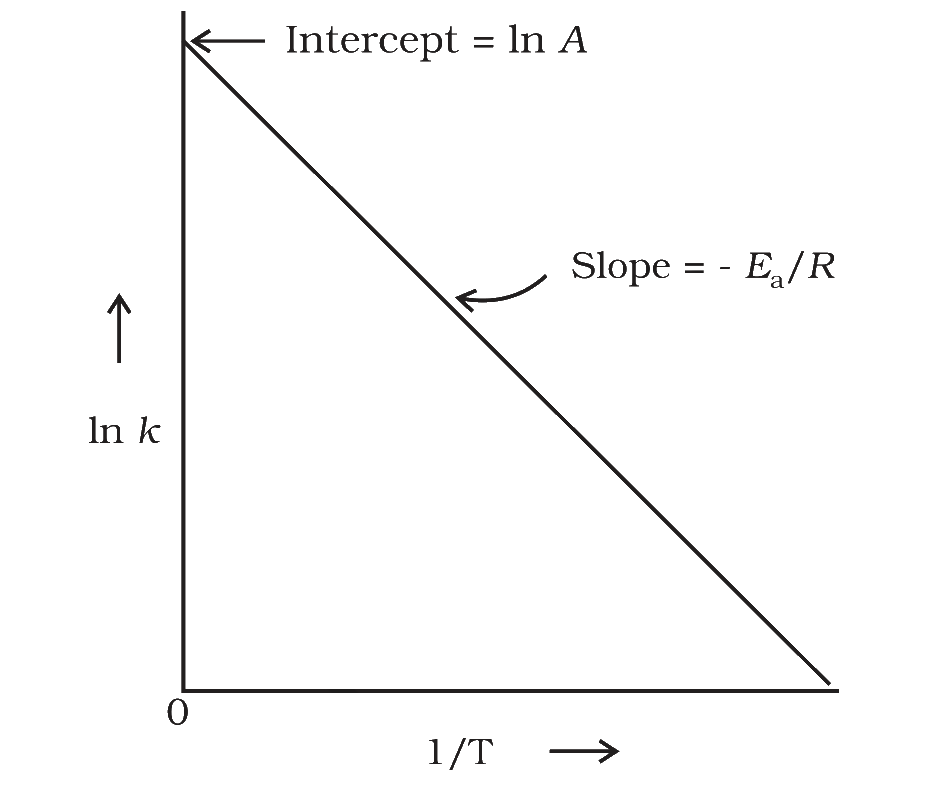
Fig. 3.10: A plot between ln k and 1/T