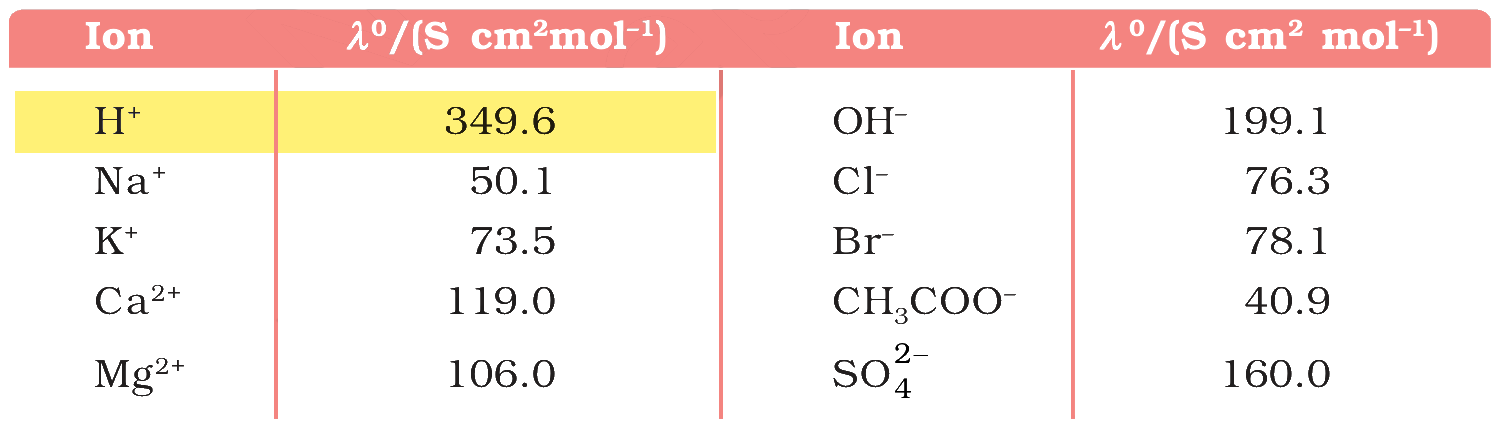
Kohlrausch examined the limiting molar conductivity (Λ°m) of a number of strong electrolytes and observed certain regularities. On the basis of these observations he enunciated the Kohlrausch law of independent migration of ions. The law states that the limiting molar conductivity of an electrolyte can be represented as the sum of the individual contributions of the anion and the cation of the electrolyte. Thus, for sodium chloride:
\(\Lambda^{\circ}_m(\text{NaCl}) = \lambda^{\circ}_{\text{Na}^+} + \lambda^{\circ}_{\text{Cl}^-}\)
Using the Kohlrausch law, it is possible to calculate Λ°m for any electrolyte from the λ° of its individual ions. For a weak electrolyte such as acetic acid, Λ°m can also be obtained from the Λ°m values of strong electrolytes:
\(\Lambda^{\circ}_m(\text{CH}_3\text{COOH}) = \Lambda^{\circ}_m(\text{CH}_3\text{COONa}) + \Lambda^{\circ}_m(\text{HCl}) - \Lambda^{\circ}_m(\text{NaCl})\)
Which of the following ions has an exceptionally high limiting molar conductivity (λ°) in water at 298 K?
Answer & explanation
Correct answer: option 1
The correct answer is Option (1) → H+
The limiting molar conductivity of \( \ce{H^+} \) in water at 298 K is 349.6 S cm2 mol−1, about three to five times that of \( \ce{Ca^2+} \) (119.0), \( \ce{Cl^-} \) (76.3) and \( \ce{K^+} \) (73.5).
NCERT (2026-27 edition):
Table 2.4: Limiting Molar Conductivity for some Ions in Water at 298 K