
The magnetic dipole moment of a bar magnet is a vector quantity directed from
Answer & explanation
Correct answer: option 2
The correct answer is Option (2) → south to north
A bar magnet behaves as an equivalent solenoid. It produces the same field lines, and its magnetic moment equals that of the solenoid. For a current loop \( \vec{m}=I\vec{A} \), and the direction of \( \vec{A} \) is given by the right-hand thumb rule. So the moment of a solenoid points along its axis, in the direction of the field inside it.
Option (1) north to south — Incorrect. North to south is the way the field lines curve back outside the magnet. The moment points along the axis the other way, in the direction of the field inside.
Option (2) south to north — Correct. Inside a bar magnet the field lines run from the south pole to the north pole and emerge at the north pole. The moment of the equivalent solenoid points along this field inside, so \( \vec{m} \) is directed from the south pole to the north pole.
Option (3) it has no direction — Incorrect. The magnetic moment is a vector (\( \vec{m}=I\vec{A} \) for a loop). The torque \( \vec{\tau}=\vec{m}\times\vec{B} \) on a magnet in a field depends on its direction.
Option (4) its direction depends on the material of the magnet — Incorrect. The direction is fixed by the poles. For every bar magnet, whatever it is made of, \( \vec{m} \) points from its south pole to its north pole.
NCERT (2026-27):
Bar Magnet as an Equivalent Solenoid – “… The magnetic moment of a bar magnet is thus equal to the magnetic moment of an equivalent solenoid that produces the same magnetic field.”
Torque on a Rectangular Current Loop in a Uniform Magnetic Field – “… We define the magnetic moment of the current loop as,
\( \mathbf{m}=I\mathbf{A} \qquad (4.22) \)
where the direction of the area vector A is given by the right-hand thumb rule …”
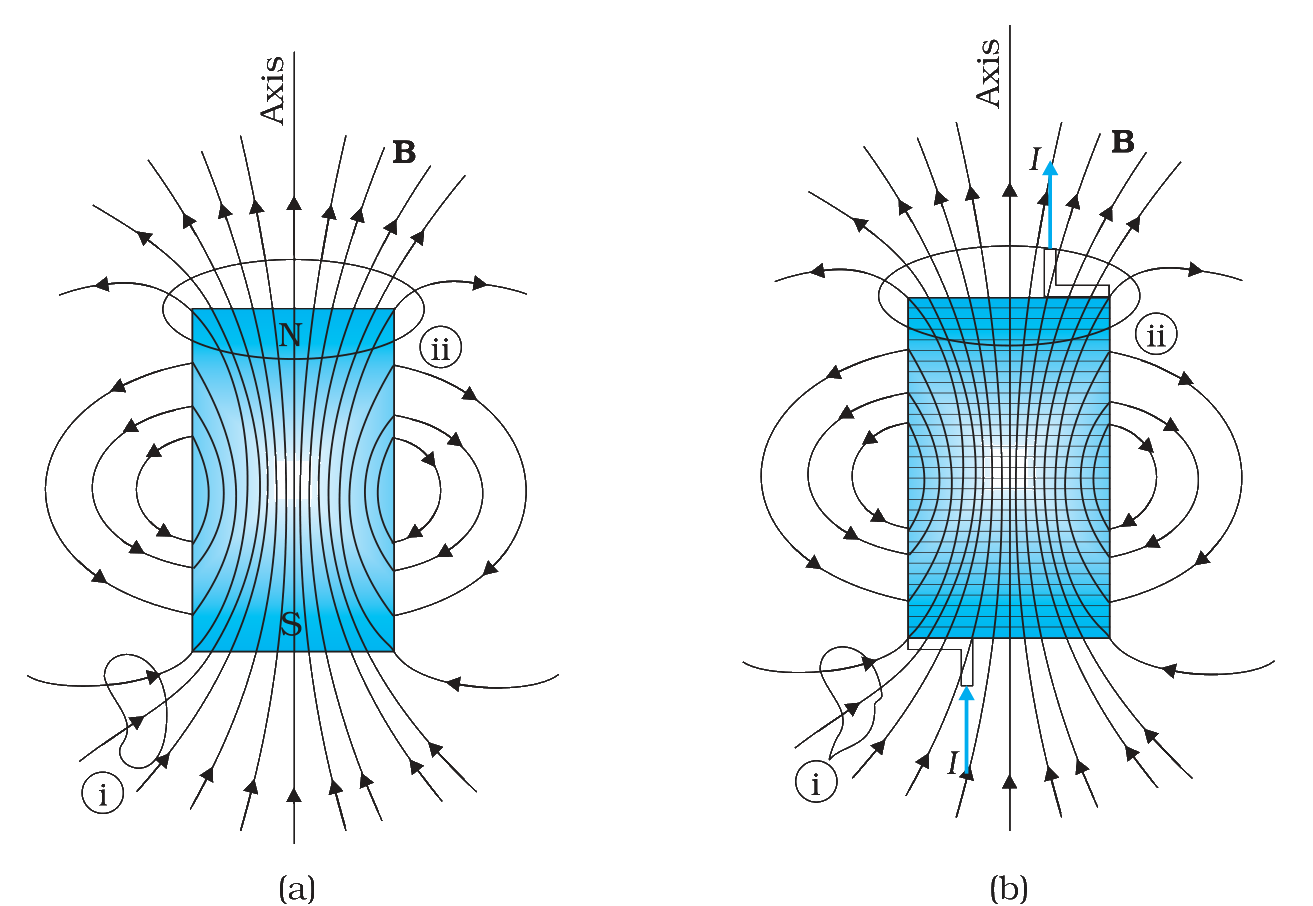
Fig. 5.2: The field lines of (a) a bar magnet, (b) a current-carrying finite solenoid.