Statement I: Coordination isomerism occurs when both the cation and the anion are complex ions.
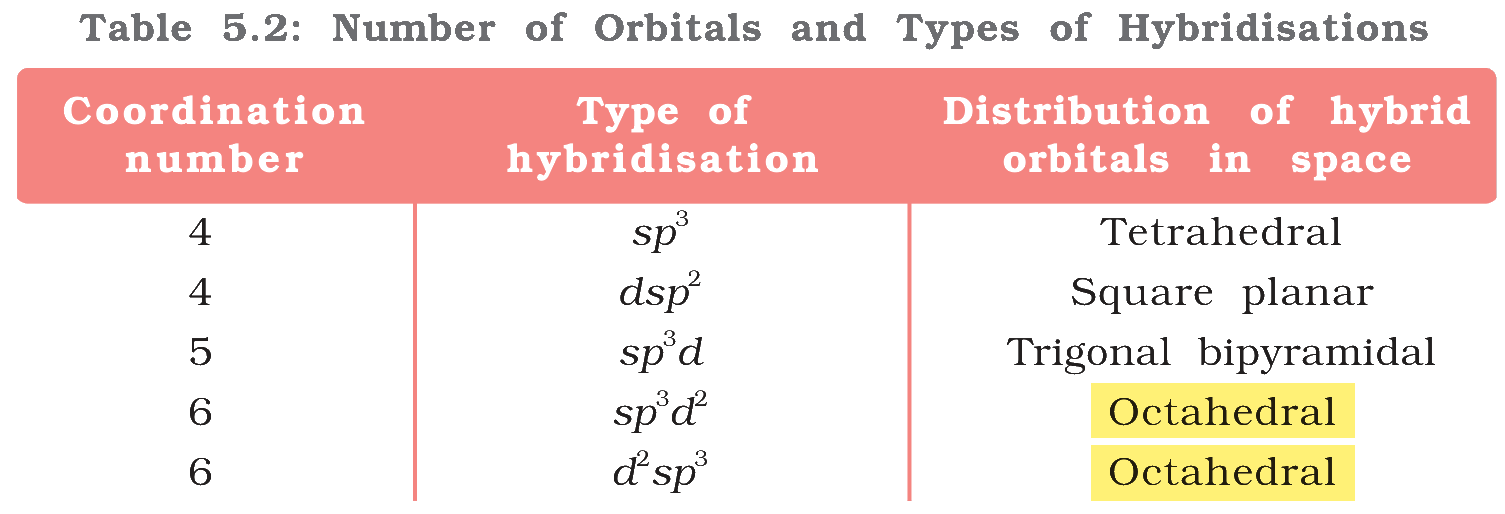
Statement II: Complexes with coordination number 6 are octahedral and involve either sp3d2 or d2sp3 hybridisation.
Answer & explanation
Correct answer: option 2
The correct answer is Option (2) → Both Statement I and statement II are true but statement II is not the correct explanation for statement I
Statement I: Coordination isomerism occurs when both the cation and the anion are complex ions. — True. Coordination isomers differ in how the ligands are shared between the cationic and anionic complex entities. In \( \ce{[Co(NH3)6][Cr(CN)6]} \) the \( \ce{NH3} \) ligands are on Co and the \( \ce{CN^-} \) ligands on Cr; in its isomer \( \ce{[Cr(NH3)6][Co(CN)6]} \) they are interchanged. This is possible only when both ions are complexes.
Statement II: Complexes with coordination number 6 are octahedral and involve either sp3d2 or d2sp3 hybridisation. — True. By valence bond theory, six hybrid orbitals point to the corners of an octahedron. They come from outer 4d orbitals (sp3d2, outer orbital complex) or from inner 3d orbitals (d2sp3, inner orbital complex).
Why Statement II does not explain Statement I?
Statement I is about a kind of structural isomerism: whether ligands can be exchanged between two complex ions of a salt. Statement II is about the geometry and hybridisation of one complex entity.
Octahedral geometry does not create coordination isomerism: \( \ce{[Co(NH3)6]Cl3} \) is octahedral but has only one complex ion, so it has no coordination isomer. The condition is the presence of a complex cation and a complex anion, which hybridisation does not explain.
NCERT (2026-27 edition):
5.4.4 Coordination Isomerism – “This type of isomerism arises from the interchange of ligands between cationic and anionic entities of different metal ions present in a complex. An example is provided by [Co(NH3)6][Cr(CN)6], in which the NH3 ligands are bound to Co3+ and the CN– ligands to Cr3+. In its coordination isomer [Cr(NH3)6][Co(CN)6], the NH3 ligands are bound to Cr3+ and the CN– ligands to Co3+.”
5.5.1 Valence Bond Theory