
Read the following passage and answer the questions.
The figure shows the set-up a student uses to study the photoelectric effect. An evacuated glass tube holds a photosensitive plate C (the emitter) and a metal plate A (the collector). Light from a source S enters through a quartz window and falls on plate C. A battery keeps a potential difference between C and A, and she can change its value. A commutator reverses the polarity, so plate A can be made positive or negative with respect to C. A voltmeter reads this potential difference, and a microammeter reads the photocurrent.
She chooses the frequency of the light by placing coloured filters in its path. She changes the intensity by moving the source nearer to or farther from plate C. For each setting, she records the microammeter reading as the potential of A is changed from a large positive value to negative values.
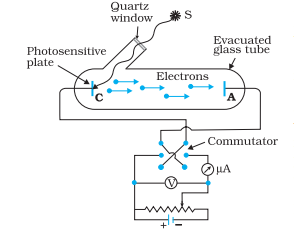
In one run, the microammeter shows a saturation current of 4.8 μA. How many photoelectrons reach plate A each second? (Take \(e = 1.6\times10^{-19}\ \mathrm{C}\).)
Answer & explanation
Correct answer: option 1
The correct answer is Option (1) → \(3.0\times10^{13}\)
At saturation, every photoelectron given out by plate C reaches plate A. Each electron carries a charge \( e \). So if \( N \) electrons reach A each second, the current is \( I=Ne \).
Given:
\( I=4.8\ \mu\mathrm{A}=4.8\times10^{-6}\ \mathrm{A} \)
\( e=1.6\times10^{-19}\ \mathrm{C} \)
\( \begin{aligned} N &= \frac{I}{e} \\ &= \frac{4.8\times10^{-6}}{1.6\times10^{-19}} \\ &= 3.0\times10^{13}\ \mathrm{s^{-1}} \end{aligned} \)
Therefore, \( 3.0\times10^{13} \) photoelectrons reach plate A every second.
NCERT (2026-27):
Effect of potential on photoelectric current – “… Saturation current corresponds to the case when all the photoelectrons emitted by the emitter plate C reach the collector plate A.”