
Haloarenes undergo the usual electrophilic reactions of the benzene ring such as halogenation, nitration, sulphonation and Friedel-Crafts reactions. Halogen atom besides being slightly deactivating is o, p-directing; therefore, further substitution occurs at ortho- and para-positions with respect to the halogen atom. The o, p-directing influence of halogen atom can be easily understood if we consider the resonating structures of halobenzene as shown:
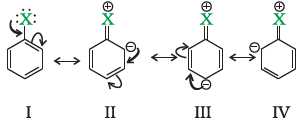 Due to resonance, the electron density increases more at ortho- and para-positions than at meta-positions. Further, the halogen atom because of its –I effect has some tendency to withdraw electrons from the benzene ring. As a result, the ring gets somewhat deactivated as compared to benzene and hence the electrophilic substitution reactions in haloarenes occur slowly and require more drastic conditions as compared to those in benzene.
Consider the following statements about why haloarenes are much less reactive than haloalkanes towards nucleophilic substitution.
(A) In chlorobenzene, the electron pairs on the chlorine atom are in conjugation with the π-electrons of the ring, so the C–Cl bond acquires a partial double bond character.
(B) In a haloarene, the carbon atom attached to the halogen is sp3 hybridised, while in a haloalkane it is sp2 hybridised.
(C) The phenyl cation formed by self-ionisation of a haloarene is not stabilised by resonance, so the SN2 mechanism is ruled out.
(D) An electron-rich nucleophile is less likely to approach an electron-rich arene because of the possible repulsion.
Which of the statements given above are correct? Choose the correct answer from the options given below:
Answer & explanation
Correct answer: option 3
The correct answer is Option (3) → (A) and (D) only
In a haloarene the C–X bond is harder to break than in a haloalkane, and the ring does not welcome a nucleophile. Four reasons are given for this.
(A) In chlorobenzene, the electron pairs on the chlorine atom are in conjugation with the π-electrons of the ring, so the C–Cl bond acquires a partial double bond character. — True. This is the resonance effect. A bond with partial double bond character is harder to cleave than the single C–Cl bond of a haloalkane.
(B) In a haloarene, the carbon atom attached to the halogen is sp3 hybridised, while in a haloalkane it is sp2 hybridised. — False. It is the other way round: the carbon is sp2 in a haloarene and sp3 in a haloalkane. The sp2 carbon holds the bond pair more tightly, so the C–Cl bond is shorter (169 pm against 177 pm) and harder to break.
(C) The phenyl cation formed by self-ionisation of a haloarene is not stabilised by resonance, so the SN2 mechanism is ruled out. — False. The first part is right, but an unstable cation rules out the SN1 mechanism, because SN1 goes through a carbocation. SN2 forms no cation.
(D) An electron-rich nucleophile is less likely to approach an electron-rich arene because of the possible repulsion. — True. The π-electron cloud of the ring repels the incoming nucleophile.
NCERT (2026-27 edition):
6.7.2 Reactions of Haloarenes – “(i) Resonance effect : In haloarenes, the electron pairs on halogen atom are in conjugation with π-electrons of the ring…” “C—Cl bond acquires a partial double bond character due to resonance. As a result, the bond cleavage in haloarene is difficult than haloalkane and therefore, they are less reactive towards nucleophilic substitution reaction.”
“(ii) Difference in hybridisation of carbon atom in C—X bond: In haloalkane, the carbon atom attached to halogen is sp3 hybridised while in case of haloarene, the carbon atom attached to halogen is sp2-hybridised.” “…Thus, C—Cl bond length in haloalkane is 177pm while in haloarene is 169 pm.”
“(iii) Instability of phenyl cation: In case of haloarenes, the phenyl cation formed as a result of self-ionisation will not be stabilised by resonance and therefore, SN1 mechanism is ruled out.”
“(iv) Because of the possible repulsion, it is less likely for the electron rich nucleophile to approach electron rich arenes.”