
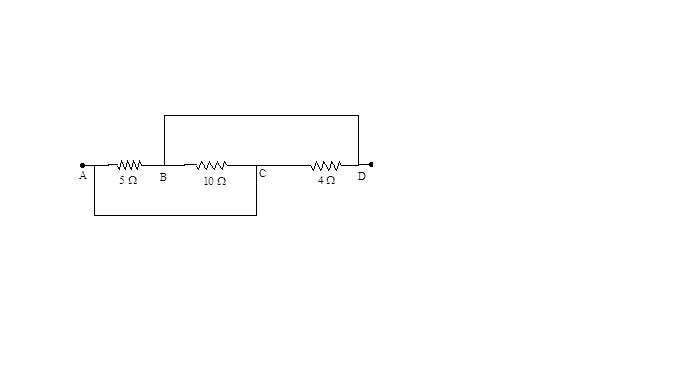
Three resistors \( 5\,\Omega \), \( 10\,\Omega \) and \( 4\,\Omega \) are connected as shown in the figure. The equivalent resistance between the points A and D is
Answer & explanation
Correct answer: option 1
The correct answer is Option (1) → \( \displaystyle\frac{20}{11}\,\Omega \)
Points joined by a plain connecting wire (no resistance) are at the same potential and can be treated as one point. Redrawing the circuit this way shows which resistors are in parallel.
From the figure, the connecting wires join these points:
- The lower wire joins A to C, so A and C are the same point.
- The upper wire joins B to D, so B and D are the same point.
Each resistor can then be placed between these merged points:
\( 5\,\Omega \) between A and B, that is, between A and D
\( 10\,\Omega \) between B and C, that is, between D and A
\( 4\,\Omega \) between C and D, that is, between A and D
All three resistors are connected between A and D, so they are in parallel.
The equivalent resistance of the three in parallel is:
\( \begin{aligned} \frac{1}{R_{\mathrm{eq}}} &= \frac{1}{5}+\frac{1}{10}+\frac{1}{4} \\ &= \frac{4+2+5}{20} \\ &= \frac{11}{20}\,\Omega^{-1} \end{aligned} \)
\( \displaystyle R_{\mathrm{eq}}=\frac{20}{11}\,\Omega\approx1.8\,\Omega \)