
CUETMOCK
  • Pricing
  • Mentors
Log inStart freeStart free mocks→

First test, then trust

Try a free CUET mock test.

Join 5,00,000+ students who rehearsed exam day on the exact NTA screen before sitting CUET. On the web and on Android.

Start free mocks →Get the Android app
CUETMOCK

India's #1 CUET Mock Test Platform. Original NCERT-based questions on the exact NTA exam screen — trusted by 5,00,000+ students since CUET 2022.

Get it onGoogle PlayScan to download the CUETMOCK app

Mock tests

  • CUET mock test series
  • Commerce mocks
  • Humanities (Arts) mocks
  • Science mocks
  • Languages & GAT mocks
  • Free practice questions
  • Pricing

Resources

  • CUET exam guide
  • CUET syllabus
  • Universities accepting CUET
  • Expert blogs
  • News & notifications
  • Webinars & counselling
  • CUET score calculator
  • How we estimate your rank
  • FAQs

Company

  • About us
  • Our leadership & team
  • Our toppers
  • Mentors
  • For schools
  • Contact us
  • Terms
  • Privacy
  • Refund policy

Talk to us

+91 7696 6630 56info@cuetmock.comWhatsApp us

Our other platforms

  • JEE Mock — For IIT-JEE aspirants
  • NEET Mock — For NEET aspirants

Newsletter

Exam updates, study material and offers — no spam.

© 2026 NYC Ventures Pvt. Ltd.

701-702, Royal Business Park, Zirakpur, Punjab - 140603

  • Terms of use
  • Privacy policy
  • Refund policy
  • Contact us

iCUETMOCK is an independent preparation platform, not affiliated with the National Testing Agency (NTA). Always check exam details on the official NTA website.

  • Home
  • Mock tests
  • CUET guide
  • Pricing
  • Log in
Home/Practice questions/Chemistry
ChemistryOrganic: Haloalkanes and Haloarenes

Which of the following describes the Fittig reaction?

Haloarenes undergo the usual electrophilic reactions of the benzene ring such as halogenation, nitration, sulphonation and Friedel-Crafts reactions. Halogen atom besides being slightly deactivating is o, p-directing; therefore, further substitution occurs at ortho- and para-positions with respect to the halogen atom. The o, p-directing influence of halogen atom can be easily understood if we consider the resonating structures of halobenzene as shown:
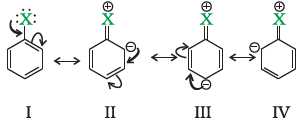
Due to resonance, the electron density increases more at ortho- and para-positions than at meta-positions. Further, the halogen atom because of its –I effect has some tendency to withdraw electrons from the benzene ring. As a result, the ring gets somewhat deactivated as compared to benzene and hence the electrophilic substitution reactions in haloarenes occur slowly and require more drastic conditions as compared to those in benzene.

Which of the following describes the Fittig reaction?

Answer & explanation+

Correct answer: option 1

The correct answer is Option (1) → An aryl halide is treated with sodium in dry ether, and two aryl groups are joined together.

Sodium in dry ether takes the halogen away from an organic halide as NaX, and the two organic groups left behind are joined together. The name of the reaction depends on which groups are joined. In the Fittig reaction both are aryl groups; chlorobenzene, for example, gives diphenyl:

    \( \displaystyle \ce{2C6H5Cl + 2Na} \xrightarrow{\text{dry ether}} \ce{C6H5-C6H5 + 2NaCl} \)

Why the other options are incorrect

Option (2) A mixture of an alkyl halide and an aryl halide is treated with sodium in dry ether to give an alkylarene. — Incorrect. This is the Wurtz-Fittig reaction: an alkyl group and an aryl group are joined, not two aryl groups.

Option (3) An alkyl halide is treated with sodium in dry ether to give a hydrocarbon with double the number of carbon atoms. — Incorrect. This is the Wurtz reaction of alkyl halides; two alkyl groups are joined, so the number of carbon atoms doubles.

Option (4) A freshly prepared benzenediazonium salt is mixed with cuprous chloride, and the diazonium group is replaced by chlorine. — Incorrect. This is the Sandmeyer reaction, a method of preparing haloarenes. No sodium is used and no two rings are joined.

NCERT (2026-27 edition):
6.7.2 Reactions of Haloarenes – “Fittig reaction Aryl halides also give analogous compounds when treated with sodium in dry ether, in which two aryl groups are joined together. It is called Fittig reaction.”

Advertisement

Practise more on Organic: Haloalkanes and Haloarenes

Chapter-wise mocks on the real NTA exam screen, with solutions and your rank. Your first mocks are free.

Start free mocks →

Advertisement

Next questions

  1. Select the number that will replace the question mark (?) in the table below.2918542076?General Aptitude Test · Verbal Reasoning
  2. Eight persons, D, E, F, G, H, I, J and K, are sitting around a square table, facing the centre. Four of them sit at the corners and four at…General Aptitude Test · Verbal Reasoning
  3. What is the molecular mass of glucose (C6H12O6)? (Atomic masses: C = 12 u, H = 1 u, O = 16 u)General Aptitude Test · General Knowledge
  4. Choose the most appropriate option to fill in the blanks in the following sentence:______ Kavya ______ her twin brother Kartik got full mar…English · Grammar: Conjunction
  5. A uniform magnetic field passes normally through the plane of a 50-turn coil. The field is reduced steadily to zero in 0.2 s. An average em…Physics · Electromagnetic Induction
  6. Two circular coils P and Q carry equal currents. They are placed in the same uniform magnetic field, with their planes parallel to the fiel…Physics · Moving Charges and Magnetism
  7. Choose the pair of words that best fills the blanks in the sentence:Seeing the snake lying ______ on the warm rock, the boys wrongly ______…English · Fill Blanks
  8. Out of the options given below, choose the one which can be substituted for the given expression:A specialist who tests people’s hearing an…English · One Word
  9. Lord William Bentinck, Governor-General, is best remembered for a law passed in 1829. What did this law do?General Aptitude Test · General Knowledge
  10. A and B are independent events such that P(A∩ B) = displaystyle1/8 and P(A'∩ B') = displaystyle3/8 . If P(A) > P(B), then P(A) is equal toMaths. Section B1 · Probability