Human beings have a need to interact with and relate to others and to explain their own as well as others’ behaviour. Because of these social interactions, people form attitudes about other individuals and also about different issues in life. These attitudes have an evaluative feature, are accompanied by an emotional component and a tendency to act in a particular way with respect to the attitude object. Negative attitudes towards others, called prejudices may be based on stereotypes. These stereotypes often assumes that all members of a specific group possess certain undesirable characteristics which leads to the formation of negative attitudes towards members of that group. Prejudice has many other sources and often creates conflict within a society. Awareness about these sources would be the one of the steps in handling these prejudices.
Match the LIST-I with LIST-II
| LIST-I | LIST-II | ||
| A. | Balance theory of Attitude change | I. | Festinger and Carlsmith |
| B. | Cognitive dissonance theory | II. | Fritz Heider |
| C. | The two-step concept | III. | S. M. Mohsin |
| D. | ‘Telling a lie for 20 dollars’ experiment | IV. | Leon Festinger |
Choose the correct answer from the options given below:
Answer & explanation
Correct answer: option 2
The correct answer is Option (2) → A-II, B-IV, C-III, D-I
(A) Balance theory of Attitude change — this matches (II) Fritz Heider. Heider’s concept of balance is described as the P-O-X triangle; an attitude changes when the three relations are out of balance.
(B) Cognitive dissonance theory — this matches (IV) Leon Festinger. The cognitive components of an attitude must be consonant; when two cognitions clash, one of them is changed.
(C) The two-step concept — this matches (III) S. M. Mohsin. The Indian psychologist held that attitude change takes place in two steps: the target first identifies with the source, then follows the source’s own change.
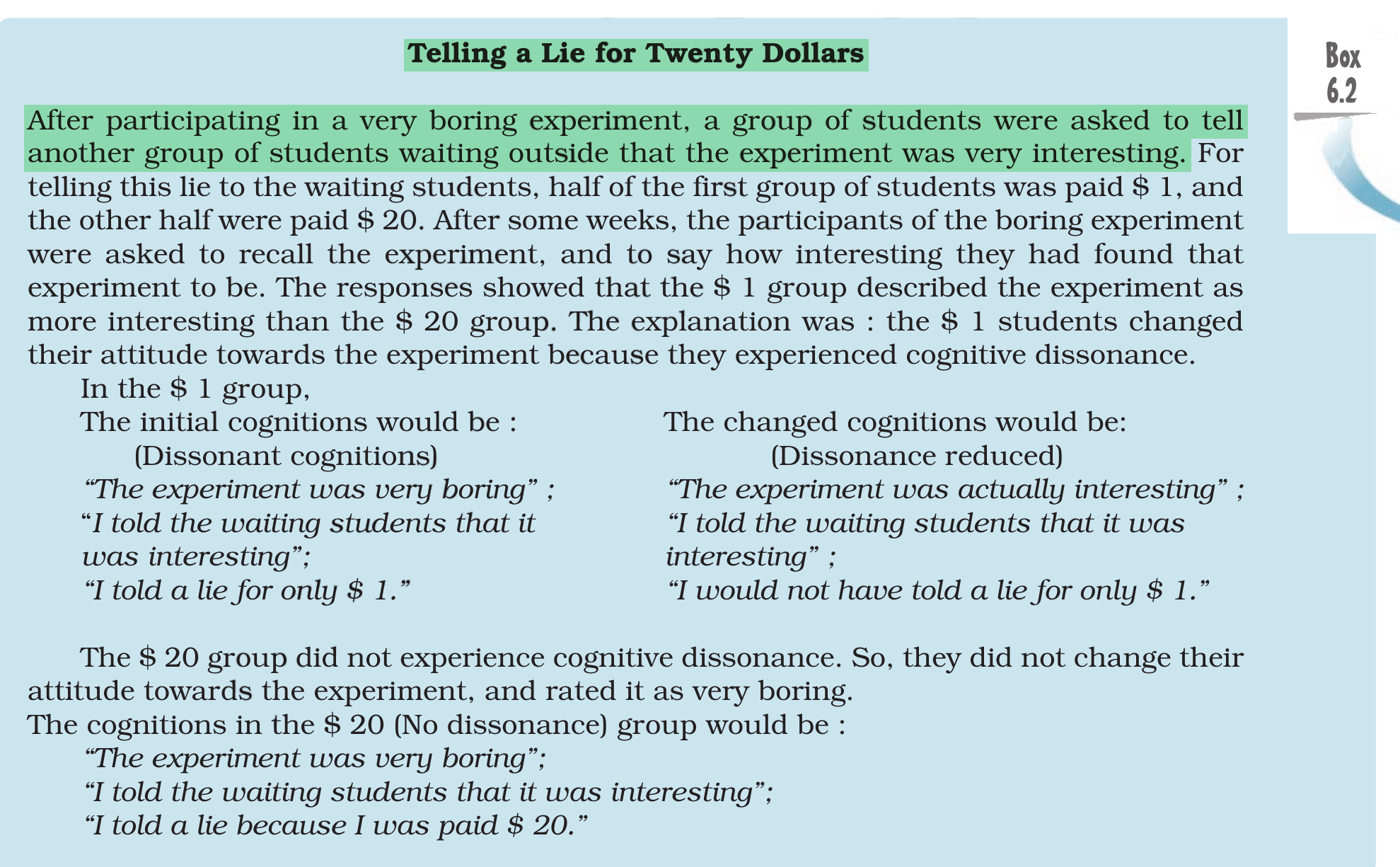
(D) ‘Telling a lie for 20 dollars’ experiment — this matches (I) Festinger and Carlsmith. Students paid $ 1 to call a boring experiment interesting later rated it more interesting than those paid $ 20, because only the $ 1 group felt cognitive dissonance.
NCERT (2025-26): “Process of Attitude Change … (a) The concept of balance, proposed by Fritz Heider is sometimes described in the form of the ‘P-O-X’ triangle, which represents the relationships between three aspects or components of the attitude. P is the person whose attitude is being studied, O is another person, and X is the topic towards which the attitude is being studied (attitude object). It is also possible that all three are persons.…” “(b) The concept of cognitive dissonance was proposed by Leon Festinger.…” “(c) The two-step concept was proposed by S.M. Mohsin, an Indian psychologist. According to him, attitude change takes place in the form of two steps.…” “…Festinger and Carlsmith, two social psychologists, conducted an experiment that showed how cognitive dissonance works (see Box 6.2).…”
|