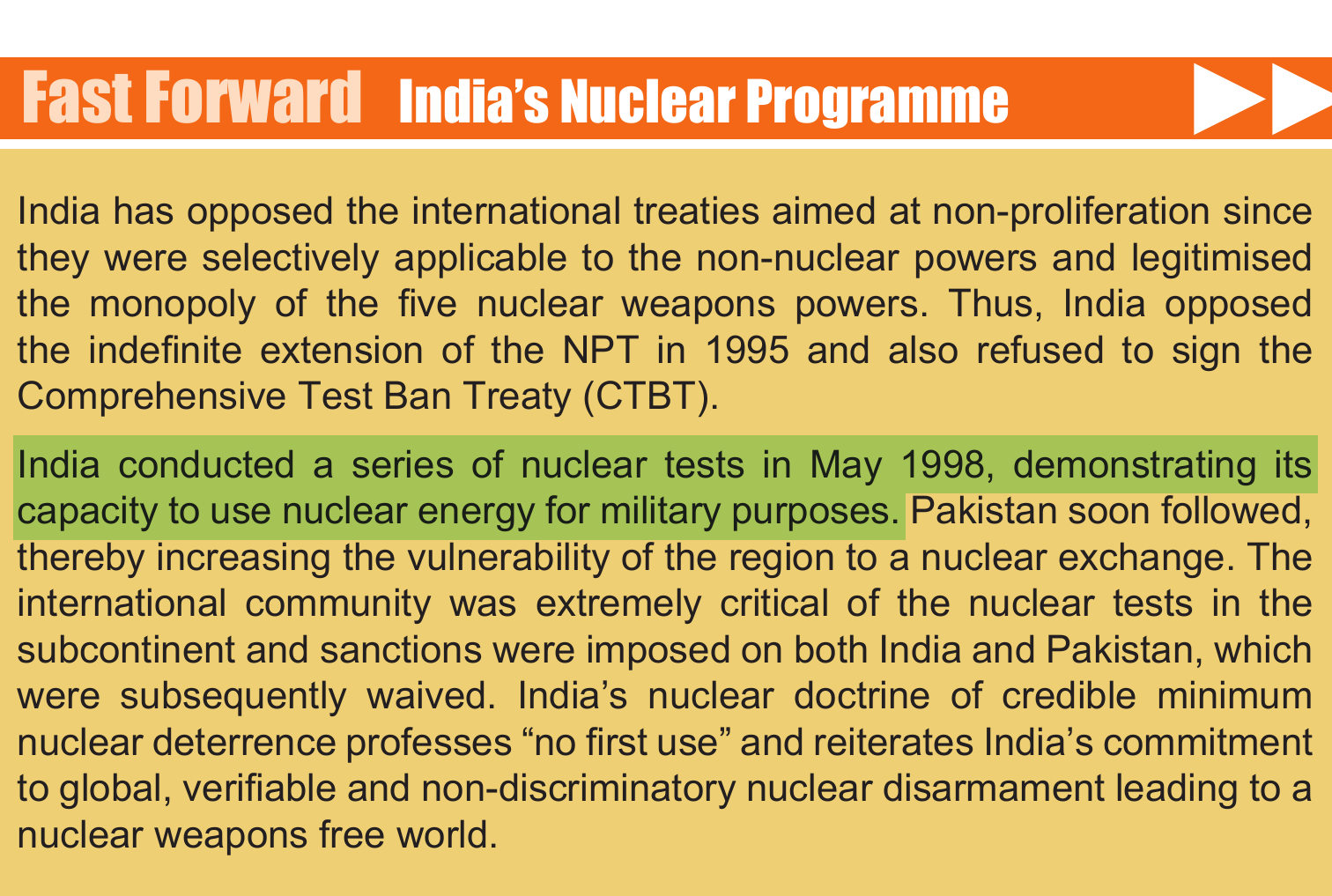
Match the LIST-I with LIST-II
| LIST-I (International events) | LIST-II (Year) | ||
| A. | Communist China conducted nuclear tests | I. | 1964 |
| B. | India conducted a series of nuclear tests to use nuclear energy for military purposes | II. | 1998 |
| C. | Asia Relations Conference | III. | 1947 |
| D. | China took over control of Tibet | IV. | 1950 |
Choose the correct answer from the options given below:
Answer & explanation
Correct answer: option 2
The correct answer is Option (2) → A – I, B – II, C – III, D – IV
(A) Communist China conducted nuclear tests — this matches (I) 1964.
(B) India conducted a series of nuclear tests to use nuclear energy for military purposes — this matches (II) 1998.
(C) Asia Relations Conference — this matches (III) 1947. India convened it in March 1947, five months before independence.
(D) China took over control of Tibet — this matches (IV) 1950.
NCERT (2025-26): “Afro-Asian unity … Throughout the 1940s and 1950s, Nehru had been an ardent advocate of Asian unity. Under his leadership, India convened the Asian Relations Conference in March 1947, five months ahead of attaining its independence.… The Chinese invasion, 1962 … Two developments strained this relationship. China annexed Tibet in 1950 and thus removed a historical buffer between the two countries.… India’s nuclear policy … Nehru was against nuclear weapons. So he pleaded with the superpowers for comprehensive nuclear disarmament. However, the nuclear arsenal kept rising. When Communist China conducted nuclear tests in October 1964, the five nuclear weapon powers, the US, USSR, UK, France, and China (Taiwan then represented China) – also the five Permanent Members of the UN Security Council – tried to impose the Nuclear Non-proliferation Treaty (NPT) of 1968 on the rest of the world. India always considered the NPT as discriminatory and had refused to sign it.…”
|