
The halogen atom in haloalkanes is more electronegative than the carbon atom attached to it. As a result, the carbon atom acquires a partial positive charge and the halogen atom a partial negative charge.
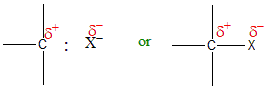
The presence of this small positive charge on the carbon atom makes it susceptible to attack by nucleophilic reagents. Thus, when a nucleophile stronger than the halide ion approaches the positively charged carbon atom of an alkyl halide, the halogen atom with its bonding pair of electrons is displaced and a new bond between the carbon atom and the incoming nucleophile is formed:

Such reactions, in which a stronger nucleophile displaces a weaker nucleophile, are called nucleophilic substitution reactions, and the atom or group which departs with its bonding pair of electrons is called the leaving group. The better the leaving group, the more easily the nucleophilic substitution reaction takes place.
Amongst the halide ions, the order in which the leaving group departs is: I− > Br− > Cl− > F−. For this reason, the order of reactivity of haloalkanes is: iodoalkanes > bromoalkanes > chloroalkanes > fluoroalkanes.
There are two types of nucleophilic substitution reactions:
(a) Substitution nucleophilic bimolecular (SN2)
(b) Substitution nucleophilic unimolecular (SN1)
What is the product formed when 2-bromo-2-methylpropane reacts with hydroxide ion?
Answer & explanation
Correct answer: option 1
The correct answer is Option (1) → 2-Methylpropan-2-ol
2-Bromo-2-methylpropane is tert-butyl bromide, a tertiary alkyl halide. The hydroxide ion replaces the bromine by nucleophilic substitution (SN1), and the bromine leaves as a bromide ion:
\( \displaystyle \ce{(CH3)3C-Br + OH^- -> (CH3)3C-OH + Br^-} \)
The product, \( \ce{(CH3)3C-OH} \), is tert-butyl alcohol, named 2-methylpropan-2-ol.
Why the other option is incorrect
Option (2) tert-Butyl carbocation — Incorrect.
In the slow first step the C–Br bond breaks to give this carbocation, but it is an intermediate.
In the second step the hydroxide ion attacks it to complete the substitution. It is not the product.
NCERT (2026-27 edition):
6.7.1 Reactions of Haloalkanes: (b) Substitution nucleophilic unimolecular (SN1) – “… The reaction between tert-butyl bromide and hydroxide ion yields tert-butyl alcohol and follows the first order kinetics, i.e., the rate of reaction depends upon the concentration of only one reactant, which is tert-butyl bromide.”