
Which of the following complex ions shows geometrical (cis-trans) isomerism?
Answer & explanation
Correct answer: option 3
The correct answer is Option (3) → [PtCl2(CN)2]2−
Geometrical (cis-trans) isomerism needs two different arrangements of the same ligands.
A square planar [MX2L2] complex has them: the two X ligands can be adjacent (cis) or opposite (trans).
\( \ce{[PtCl2(CN)2]^2-} \) is a four-coordinate Pt(II) complex, square planar like \( \ce{[PtCl4]^2-} \), of the type [MX2L2] with X = \( \ce{Cl^-} \) and L = \( \ce{CN^-} \), so it has cis and trans isomers.
Why the other options are incorrect
Option (1) [PdCl3(NH3)]− — Incorrect. It is of the type [MX3L]: wherever the single \( \ce{NH3} \) sits, it has Cl on both sides and Cl opposite, so there is only one arrangement.
Option (2) [CoCl(NH3)5]2+ — Incorrect. It is an octahedral [MXL5] complex; a single Cl has no second Cl to be cis or trans to, so all positions give the same complex.
Option (4) [Pt(C2O4)2]2− — Incorrect. Both ligands are the same didentate oxalate ion; each spans two adjacent positions of the square, so only one arrangement is possible.
NCERT (2026-27 edition):
5.4.1 Geometric Isomerism – “… In a square planar complex of formula [MX2L2] (X and L are unidentate), the two ligands X may be arranged adjacent to each other in a cis isomer, or opposite to each other in a trans isomer as depicted in Fig. 5.2.”
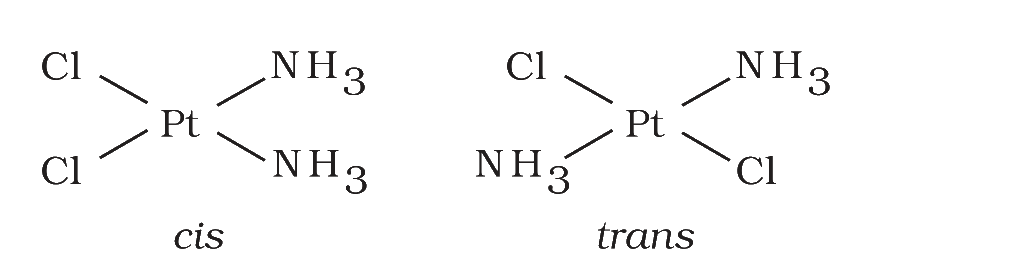
Fig. 5.2: Geometrical isomers (cis and trans) of Pt [NH3)2Cl2]