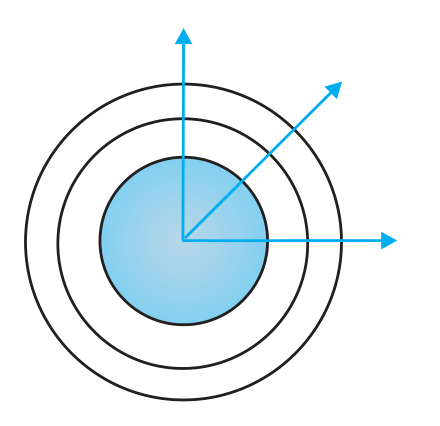
The geometrical shape of the wavefront from a point light source and a portion of the wavefront from a distant star intercepted by the earth are:
Answer & explanation
Correct answer: option 1
The correct answer is Option (1) → spherical and plane wave fronts, respectively.
A wavefront is a surface on which all points vibrate in the same phase. Light from a point source spreads out equally in all directions, so the wavefronts are spheres centred on the source.
A star is so far away that the part of its huge spherical wavefront reaching the earth has a negligible curvature; over that small portion it is effectively a plane wavefront.
NCERT (2026-27):
Huygens Principle – “… Such a locus of points, which oscillate in phase is called a wavefront; thus a wavefront is defined as a surface of constant phase.”
Huygens Principle – “… If we have a point source emitting waves uniformly in all directions, then the locus of points which have the same amplitude and vibrate in the same phase are spheres and we have what is known as a spherical wave as shown in Fig. 10.1(a). At a large distance from the source, a small portion of the sphere can be considered as a plane and we have what is known as a plane wave [Fig. 10.1(b)].”