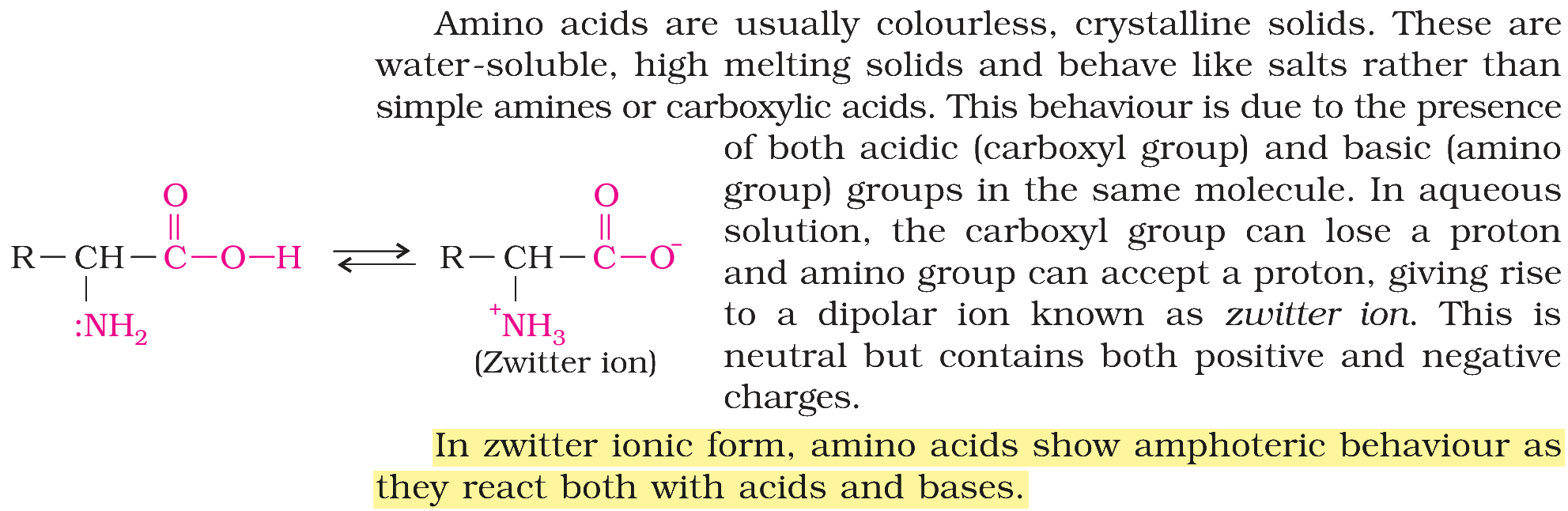
What kind of behavior is shown in the Zwitter ionic form of amino acids?
Answer & explanation
Correct answer: option 2
The correct answer is Option (2) → Amphoteric behaviour
In the zwitter ion form the amino acid can react with both acids and bases, which is amphoteric behaviour. The –\( \ce{COO^{-}} \) end takes up \( \ce{H+} \) from an acid, and the –\( \ce{NH3^{+}} \) end gives \( \ce{H+} \) to a base:
\( \displaystyle \ce{H3N+-CH(R)-COO^- + H+ -> H3N+-CH(R)-COOH} \)
\( \displaystyle \ce{H3N+-CH(R)-COO^- + OH^- -> H2N-CH(R)-COO^- + H2O} \)
Why the other options are incorrect
Option (1) Di-polar behaviour — Incorrect. “Dipolar ion” is the name of the zwitter ion itself, a description of its structure; the behaviour it shows towards acids and bases is amphoteric.
Option (3) Intermolecular H-bonding — Incorrect. The salt-like properties of amino acids (high melting points, solubility in water) come from the attraction between the charged ends of the dipolar ions; hydrogen bonding is not the behaviour that the zwitter ion form is known for.
Option (4) Peptide behavior — Incorrect. There is no such behaviour. A peptide bond is the amide link, –CO–NH–, formed when the carboxyl group of one amino acid condenses with the amino group of another.
NCERT (2026-27 edition):
Classification of Amino Acids – …